Hoof Abscesses: Signs, Treatment, and Prevention
A horse that’s sound at the evening feed and three-legged lame by morning is almost always telling you one thing: there’s an abscess brewing in that hoof.
Carrick came in from the paddock one July morning barely willing to touch his near-fore to the ground. No swelling, no cut, no obvious cause — just a horse who, an hour earlier, had been cantering the fence line for the sheer joy of it. By the time the farrier pulled the shoe and found the tell-tale dark track in the sole, it was clear: an abscess, working its way toward the surface.
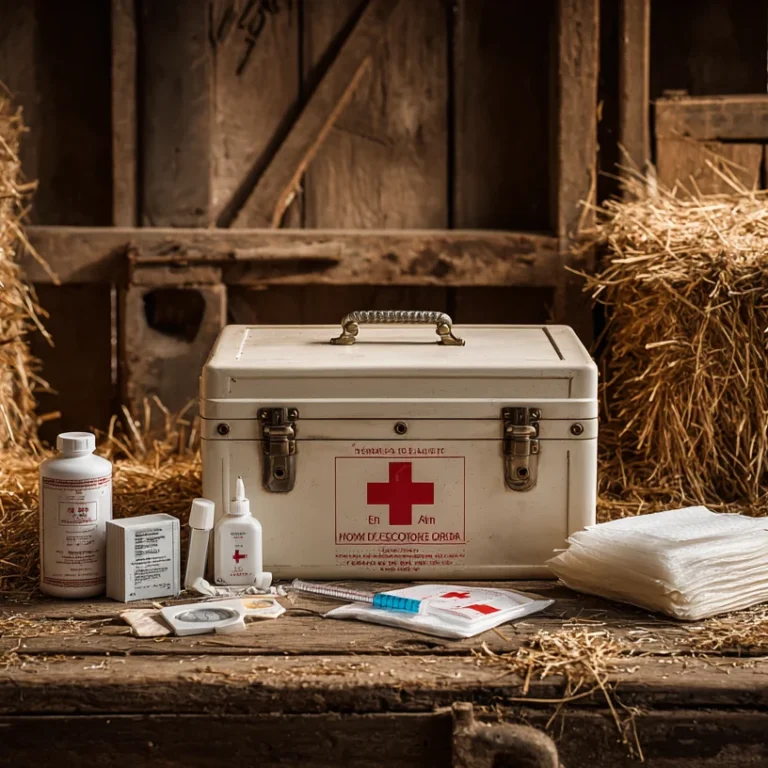
If you’ve stood in that same yard, watching a sound horse go suddenly, dramatically lame over what looks like nothing, you already know how alarming a hoof abscess feels in the moment — and how simple the fix usually turns out to be once you know what you’re dealing with. Over four and a half decades around horses, I have dealt with more abscesses than I could count, and the pattern rarely changes: sudden panic, a bit of detective work, and a horse who is sound again within a week or two. It’s exactly the kind of moment where having a stocked first aid kit already in the barn makes all the difference.
Free Horse First Aid Kit Checklist
Everything you need on hand before the next hoof emergency catches you off guard.
Download Free →What a Hoof Abscess Actually Is
A hoof abscess is a pocket of infection trapped inside the hoof capsule, usually the result of bacteria that have found their way in through a crack, a nail hole, a bruise, or a soft spot at the sole-wall junction. The hoof wall doesn’t let that infection expand outward the way a soft-tissue wound would, so the pressure builds inward instead, against nerve-rich tissue that was never built to absorb it.
That trapped pressure is the whole story behind why abscesses cause such dramatic lameness. A wound almost anywhere else on a horse’s body has somewhere to swell. Inside a rigid hoof capsule, there is nowhere for that fluid to go except against the sensitive laminae and the coffin bone itself — which is why a pocket of infection no bigger than a coin can leave a twelve-hundred-pound animal unwilling to put a foot on the ground. The American Association of Equine Practitioners covers the veterinary side of this in more depth if you want to dig further into the mechanics.
What Causes Them
- Bacterial entry: Bacteria work their way in through a crack, puncture, or weak spot in the hoof wall or white line — often ones too small to spot on a casual glance.
- Trauma or bruising: A stone bruise or a hard knock against uneven ground can damage the sensitive tissue underneath and set an infection in motion, sometimes weeks after the original knock.
- Poor hoof balance: A hoof that’s out of balance — long toe, underrun heel, an overdue trim — carries stress unevenly and opens the door to abscess formation at the weak points.
- Wet-to-dry cycling: Hooves that swing between soggy paddocks and baked-hard ground expand and contract repeatedly, which weakens the wall and the white line over time.
- A retained nail or old injury: Occasionally an abscess is the hoof’s delayed response to a nail that went slightly wrong months earlier, or an old bruise that never fully resolved.
Signs and Symptoms to Watch For
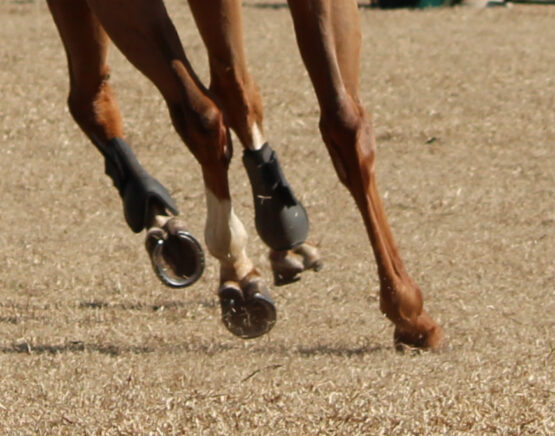
Abscess lameness tends to arrive fast and hit hard, which is often what throws owners — the sudden severity feels out of proportion to what you can actually see. Daisy once went from grazing quietly to refusing to load any weight on a hind foot within the space of an afternoon, which is about as textbook as it gets.
- Sudden, severe lameness: Often the horse will barely touch the toe down, or refuse to bear weight at all — frequently graded as a 4 or 5 out of 5 on a standard lameness scale.
- Heat in the hoof: The wall or coronary band will often feel noticeably warmer than the other three feet when you run a hand around it.
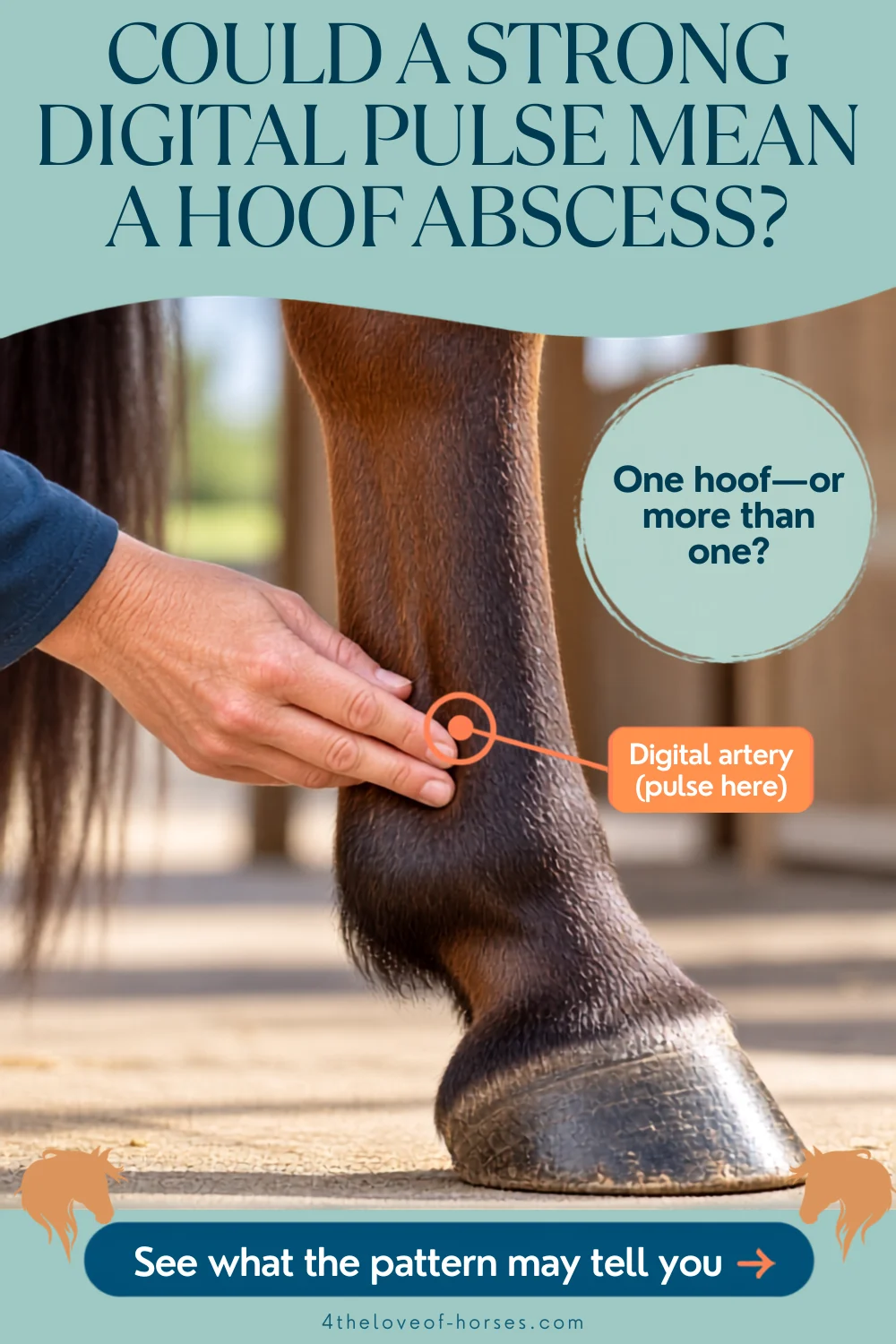
- A bounding digital pulse: Run two fingers down the back of the fetlock — a strong, easy-to-find pulse on the affected leg is a classic sign.
- Reluctance to move: Some horses will stand resting the toe, or refuse to walk on hard ground altogether, preferring soft footing if given the choice.
- Swelling up the leg: In more advanced cases, mild swelling can travel up the pastern or fetlock as the infection searches for a way out.
- A change in temperament: Even a normally easy-going horse can turn short-tempered or unusually still when standing on a throbbing abscess.
Tip
Compare the digital pulse on the sore leg against the opposite, sound leg. A pulse you can feel easily on one side and barely find on the other is a strong clue you’re dealing with an abscess rather than a strain. Practice finding a normal pulse on a healthy horse so you know what you’re comparing against when it matters.
Getting a Diagnosis
Your vet or farrier will usually start with hoof testers, working systematically around the sole and wall until they find the spot that makes the horse flinch. That’s often enough to confirm an abscess and locate it precisely, without needing to reach for imaging at all.
Where the picture isn’t clear-cut, an X-ray can rule out a fracture, a foreign body lodged in the sole, or changes to the coffin bone, and in more complicated or recurring cases an ultrasound can show how far the infection has tracked through the soft tissue. Neither is routine for a straightforward first-time abscess, but both earn their place when the lameness doesn’t fit the usual pattern.
Worth Knowing
Not every sudden lameness is an abscess. Fractures, deep puncture wounds, and laminitis can all mimic the early signs — and laminitis in particular needs a very different, much faster response. If you’re not certain, treat it as a vet call rather than a guess.
Treating the Abscess
Most abscesses respond well to a combination of soaking and poulticing at home, alongside guidance from your vet or farrier on where the pocket is likely sitting.
Soaking
Warm water and Epsom salts remain the simplest first response. Mix roughly a cup or two of Epsom salts per gallon of warm water — warm, not hot, similar to a comfortable bath temperature — and soak the hoof for fifteen to twenty minutes, once or twice a day, until the abscess breaks and drains. A rubber tub or a purpose-made soaking boot makes this far less of a wrestle than a bucket alone.
Poulticing
A poultice draws the infection the rest of the way out once soaking has softened the tissue. Clean and dry the hoof, pack the sole generously with a commercial poultice pad or a homemade mix of Epsom salts and clay, and wrap it securely with a bandage or poultice boot. Leave it in place for twenty-four to forty-eight hours, then check progress and repeat as needed until you see a clear drainage tract or a noticeable improvement in the horse’s comfort.
Medication
Your vet may prescribe antibiotics or an anti-inflammatory such as bute, particularly if the horse is in significant pain or the infection is slow to resolve. These should always be used under veterinary direction rather than pulled from the barn cabinet on a hunch — bute in particular can mask pain enough that a horse overuses the foot before it’s ready.
Resection
In stubborn or chronic cases, a vet or farrier may need to remove a section of hoof wall or sole to open a direct drainage path. This is a hands-on procedure and should only ever be carried out by a qualified professional, usually reserved for abscesses that haven’t responded to soaking and poulticing after a week or so.
Call the Vet
Severe swelling up the leg, a foul discharge, a fever, or lameness that doesn’t start easing within a few days of treatment are all signs the infection may be more serious than a straightforward abscess. Don’t wait it out.
What to Expect: A Rough Timeline
Every abscess is a little different, but a typical case follows a fairly predictable arc:
- Day 1–2: Sudden, severe lameness. This is usually the worst the horse will feel throughout the whole episode.
- Day 2–5: Soaking and poulticing begin working the abscess toward a drainage point, either through the sole, the coronary band, or an opening the farrier creates.
- Day of drainage: Often dramatic relief within hours of the abscess breaking — many horses go from barely walking to noticeably more comfortable almost overnight.
- Following week: Continued improvement as the tract closes over and the hoof finishes healing, with light exercise reintroduced gradually.
If a horse hasn’t shown any improvement after five to seven days of consistent treatment, that’s the point to loop your vet back in rather than continuing to wait.
Related Conditions Worth Knowing
A few other hoof problems get lumped in with abscesses because they share similar symptoms, but each has its own quirks:
- Gravel: An older term for an abscess that tracks upward and breaks out at the coronary band rather than draining through the sole — the pressure simply finds the path of least resistance.
- Seedy toe (white line disease): A separation of the hoof wall at the white line that can create the entry point for the bacteria that eventually causes an abscess.
- Cellulitis: A more serious bacterial infection of the soft tissue that can develop if an abscess isn’t drained and the infection spreads upward into the leg — one of the reasons persistent swelling deserves a vet visit.
Aftercare and Prevention
Once the abscess has drained, the job shifts to keeping the hoof clean and dry while it finishes healing, and watching for any return of heat or lameness. Light, gentle exercise helps circulation without undoing the progress, though it’s worth holding off on hard work or deep footing until the drainage tract has closed over.
Looking ahead, most abscesses come back to the same handful of root causes — so the prevention list is short and worth taking seriously:
- Keep trims on schedule. A hoof that’s allowed to grow long and unbalanced carries stress unevenly, usually every four to six weeks depending on growth rate.
- Work with a good farrier. Proper shoeing and balance take pressure off the structures most prone to abscessing, and a farrier who knows your horse will often spot a weak spot before it becomes a problem.
- Manage the environment. Dry, well-drained turnout and clean bedding keep hooves from softening in constant wet, and picking out feet daily catches small stones and debris before they cause bruising.
- Feed for hoof health. A balanced diet with the right minerals — particularly zinc, copper, and biotin — supports stronger horn growth from the inside out. If you’re not sure your horse’s ration is hitting the mark, this feeding guide is a good place to start.
- Know your horse’s normal. Running a hand down each leg and checking digital pulses regularly, even when nothing’s wrong, makes it far easier to spot when something is.
Frequently Asked Questions
Can a horse still be ridden with a hoof abscess?
Not while it’s acutely lame. Most horses will tell you clearly that they aren’t willing, and pushing through it risks compensatory strain elsewhere. Once the abscess has drained and comfort has returned, a gradual return to work is usually fine.
How do I know if it’s an abscess or something worse?
A hallmark abscess is sudden and severe, with heat and a strong digital pulse, but no visible wound. If the lameness comes with significant swelling, a fever, or affects more than one foot at once, treat it as a vet call rather than assuming it’s a simple abscess.
Do abscesses come back?
A horse that’s had one abscess isn’t more prone to another simply because of that history, but if the underlying cause — poor hoof balance, a damaged white line, a wet environment — isn’t addressed, the conditions that produced the first one are still there to produce a second. If you’re newer to horse ownership, our essential care guide covers the daily habits that help prevent this and other common issues before they start.
What You’ll Need on Hand
A soaking boot or rubber tub, Epsom salts, poultice pads or clay, self-adhesive bandage, and a hoof pick — keeping these together in one spot means you’re not hunting for supplies while your horse stands on three legs.
Most abscesses look far worse than they are — a little patience, a warm soak, and the right eye for the early signs will see your horse through it.
Free Horse First Aid Kit Checklist
Keep the essentials on hand so the next hoof scare doesn’t catch you unprepared.
Download Free →