The Horse’s Lower Leg: A Complete Guide — and What Can Go Wrong
No muscle below the knee — just bone, tendon and ligament, working under enormous load. Here’s what’s actually in there, and how to tell when something’s wrong.
I’ve run my hands down enough horses’ legs over 25+ years to know that most owners can find a swelling — but far fewer know what it actually means once they’ve found it. That gap is what this guide is for. It won’t make you a vet, and it’s not meant to replace one, but it will mean that when you do call, you can describe exactly what you’re feeling and where — and that alone can change how fast your horse gets the right treatment.
The Skeleton: Cannon Bone and Splint Bones
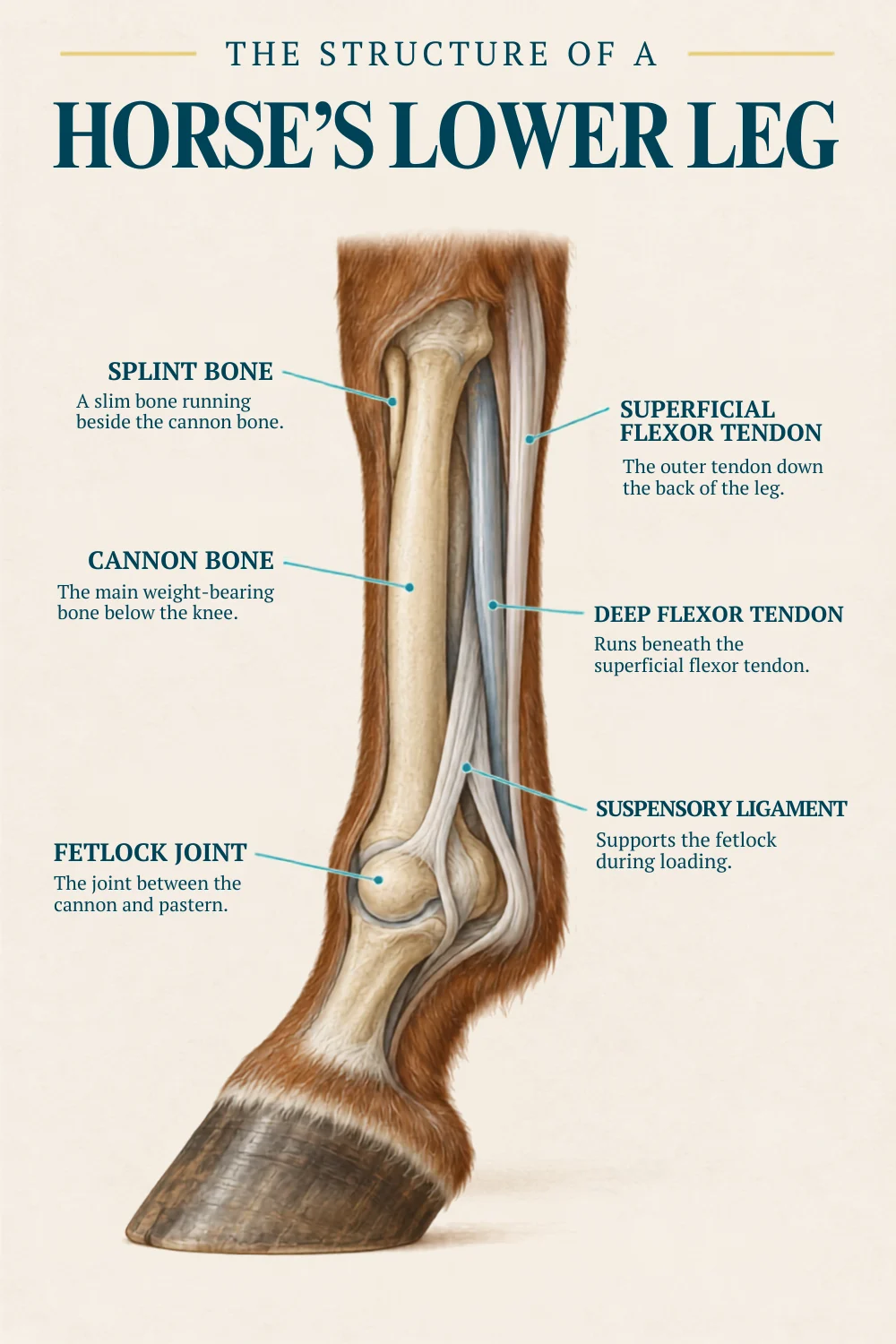
The cannon bone is the long, weight-bearing bone running from the knee (or hock, in the hind leg) down to the fetlock. It’s the main structural pillar of the lower leg, and it takes the full force of the horse’s weight with every stride.
Running down either side of the cannon bone are the two splint bones — the remnants of the side toes horses had millions of years ago, before evolution narrowed them down to a single, load-bearing digit. They’re smaller and don’t carry weight the way the cannon does, but they’re a genuinely common injury site: a “splint” is inflammation where a splint bone attaches to the cannon, usually from direct trauma (a knock) or the strain of hard work, and it shows up as a firm, often painful swelling along the inside or outside of the cannon.
The Tendons That Do the Heavy Lifting
Two major flexor tendons run down the back of the cannon bone, and telling them apart matters because they behave very differently when injured:
The superficial digital flexor tendon (SDFT) runs closer to the skin, down the back of the leg, and attaches around the back of the pastern. It’s the tendon most people mean when they talk about a “bowed tendon” — a strain injury that causes the classic convex, bowed swelling down the back of the leg.
The deep digital flexor tendon (DDFT) runs deeper, tucked behind the SDFT, and continues all the way down to attach to the coffin bone inside the hoof itself. Because it runs deeper and further, DDFT injuries can be harder to spot from the outside and often need ultrasound to properly diagnose — which is exactly why “it doesn’t look that swollen” isn’t the same as “it’s fine.”
💡 Worth Knowing
Both flexor tendons work under tension every single stride, with very little blood supply to help them heal quickly — which is why tendon injuries are notoriously slow to recover from, and why catching one early genuinely changes the outcome. World Horse Welfare’s guidance on tendon and ligament injuries is a good outside resource if you want to understand recovery timelines and prevention in more depth.The Suspensory Ligament: The Sling That Holds It All Together
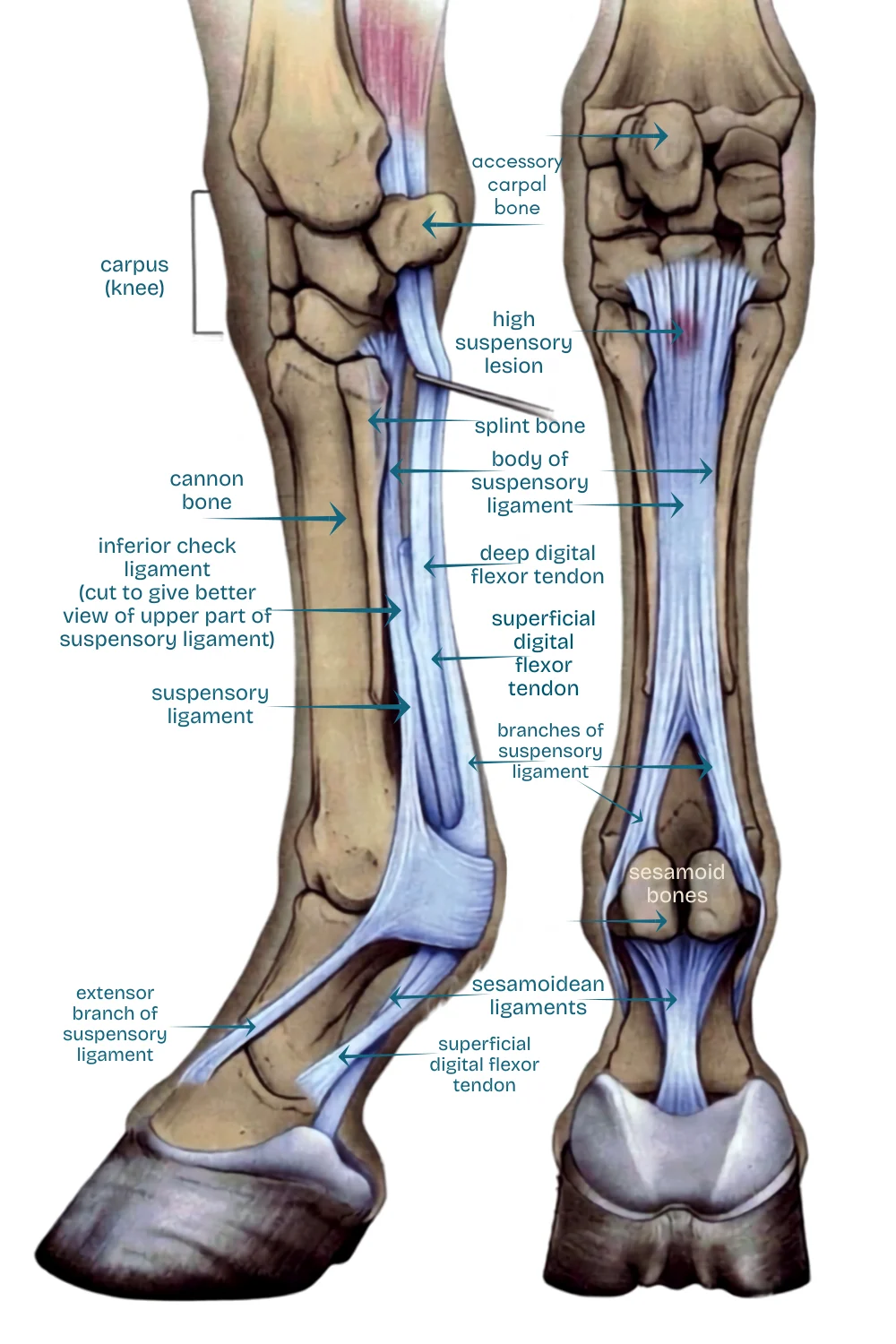
The suspensory ligament starts high up at the back of the cannon bone, runs down between the splint bones, and then splits into two branches that attach either side of the fetlock joint. Its job is to support the fetlock and stop it from dropping too far during weight-bearing — think of it as a sling that catches the joint on every stride.
It’s one of the most commonly injured structures in performance horses, particularly in disciplines with a lot of turning, jumping, or hard ground work, because it’s under constant, repetitive strain. Suspensory injuries can affect the body of the ligament higher up the leg, or just one of the two branches lower down near the fetlock — which is another reason exact location matters so much when something’s swollen (more on that below).
The Fetlock and Pastern: Where Everything Comes Together
The fetlock is the large joint at the bottom of the cannon bone — essentially the horse’s ankle — where the cannon, the long pastern bone, and the sesamoid bones all meet, with the suspensory ligament and both flexor tendons running past or attaching around it. It’s a genuinely busy piece of anatomy, and a lot can go wrong in a fairly small area.
Below the fetlock, the long and short pastern bones form the pastern itself, running down to the coffin joint inside the hoof. Pastern angle matters more than most owners realise — too upright or too sloping, and the shock absorption through the whole leg changes, which is part of why conformation and lower leg soundness are so closely linked. It’s also why the leg and the hoof really need to be thought of as one connected system — our complete guide to keeping your horse’s hooves healthy picks up exactly where this leaves off, right down at the coffin bone.
How to Check Your Horse’s Leg
A proper hands-on check takes two minutes and tells you far more than a glance across the stable ever will — and it pairs naturally with knowing your horse’s normal vital signs, since a raised pulse or temperature alongside leg changes tells a very different story than leg changes alone. Here’s the routine I use, every single time, on every horse:
- Always compare both legs. Run your hands down the “good” leg first so you know what normal feels like on that horse, that day — then check the leg you’re worried about.
- Feel for heat. Use the back of your hand or fingers, run them down the leg from knee/hock to fetlock, and compare side to side. Heat in one spot that isn’t mirrored on the other leg is your first clue.
- Check the digital pulse. Found at the back of the fetlock — a strong, bounding pulse compared to the other leg is a genuine red flag, not something to wait on.
- Feel for swelling. Run your hands down slowly, feeling for any thickening, puffiness, or a change in the normal contours of the tendons and ligament.
- Watch for pain response. Gently press along the tendons and ligament — flinching, pulling the leg away, or pinning ears at a specific spot tells you where it hurts, not just that something does.
- Look for asymmetry from a distance too. Step back and compare the overall shape and fill of both legs side by side — some swelling is more obvious from a few metres away than up close.
Why the Exact Location of Swelling Matters
“My horse has a swollen leg” tells a vet almost nothing on its own. Where exactly the swelling sits changes what it likely is, how urgent it is, and what happens next — which is why learning to describe location precisely is one of the single most useful skills an owner can have.
Right over a tendon
Swelling directly over the SDFT or DDFT, especially with heat and pain on pressure, points toward a tendon strain — treat it as urgent.
Around the fetlock joint itself
A soft, fluid-filled swelling right around the joint often means joint effusion — fluid within the joint capsule, which needs proper assessment.
Along the splint bone
A firm, well-defined lump along the inside or outside of the cannon, away from the tendons, is the classic picture of a splint.
Diffuse, all down the leg
General puffiness with no obvious single spot can be simple “stocking up” from standing still — or, with heat and pain, a sign of infection or cellulitis.
As a general rule: swelling that’s localised, hot, and painful to the touch is far more concerning than swelling that’s soft, cool, and pits when you press a finger into it (a classic sign of simple fluid/stocking up rather than injury). But “far more concerning” still means “call the vet to confirm,” not “diagnose it yourself and move on.”
🚨 When Your Horse Needs the Vet
- Non-weight-bearing lameness — a horse that won’t put any weight on the leg needs a vet immediately, no exceptions.
- Heat, swelling and pain together — any one alone can be minor; all three together is a genuine warning sign.
- A strong, bounding digital pulse compared to the other leg.
- A wound anywhere near a joint or tendon sheath — even a small puncture here can lead to a joint infection, which is a genuine emergency. Our step-by-step wound care guide covers exactly how to tell when a wound is more serious than it looks.
- Sudden, severe swelling that comes on quickly rather than gradually.
- Any visible deformity or suspicion of a fracture — keep the horse as still as possible and call immediately.
- You’re simply not sure. A phone call costs you nothing. A missed tendon injury can cost months.
⚠️ What NOT to Do Before It’s Been Assessed
- Don’t give pain relief before the vet has seen it. Masking pain can hide exactly the information a vet needs to localise the problem.
- Don’t wrap it tightly without knowing what you’re dealing with. The wrong pressure over certain injuries can make things worse, not better.
- Don’t trot the horse up repeatedly to “test” it. If there’s any chance of a fracture or severe tendon/ligament tear, repeated movement can turn a manageable injury into a catastrophic one.
- Don’t assume mild heat or filling will just resolve on its own without at least a phone call to describe it — you don’t have to book an emergency callout to ask a professional opinion.
- Don’t ignore a wound near a joint because it “looks small.” Size on the surface tells you nothing about what’s happening underneath.
Putting It All Together
None of this is about turning yourself into a vet — it’s about giving your horse the best possible chance if something does go wrong. A horse owner who can say “there’s heat and a firm swelling right over the suspensory branch on the inside of the near fore, and he’s flinching when I press it” is going to get a faster, more accurate response than one who says “his leg looks a bit puffy.” That difference is entirely learnable, and now you’ve got it. If you want the wider picture of what counts as a genuine emergency versus something that can wait for a routine visit, 10 Signs Your Horse Needs the Vet Right Now is a good companion read to this one.
Keep This Guide On Hand
Pair this with a proper first aid kit so you’re ready the moment something looks off — not scrambling to find supplies while you’re still working out what you’re looking at.
Get the Free First Aid Kit ChecklistBecause the best time to prepare is before you need it