How Much Hay Does Your Horse Actually Need?

How Much Hay Does Your Horse Actually Need?
Most horse owners are either overfeeding or underfeeding hay — and most don’t know which. Here’s how to calculate the right amount for your horse, your situation, and your goals.
Of all the questions I am asked about horse nutrition, this is the one I hear most often — and the one where the answer most frequently surprises people. The assumption is usually that their horse is getting enough hay. In my experience, after 45 years with horses, the reality is often quite different. Either the horse is getting less than they need, causing problems that are being treated with supplements and hard feed adjustments when the real answer is simply more forage — or the horse is getting hay that is inappropriate for their condition, and the amount is almost beside the point.
Getting the hay right is the single most impactful thing you can do for your horse’s nutrition. It underpins everything else — digestive health, weight management, gut microbiome stability, behaviour and overall wellbeing. Everything else you feed your horse is built on top of the forage foundation. Let’s make sure that foundation is correct.
The Basic Rule — And Why It Is Just a Starting Point
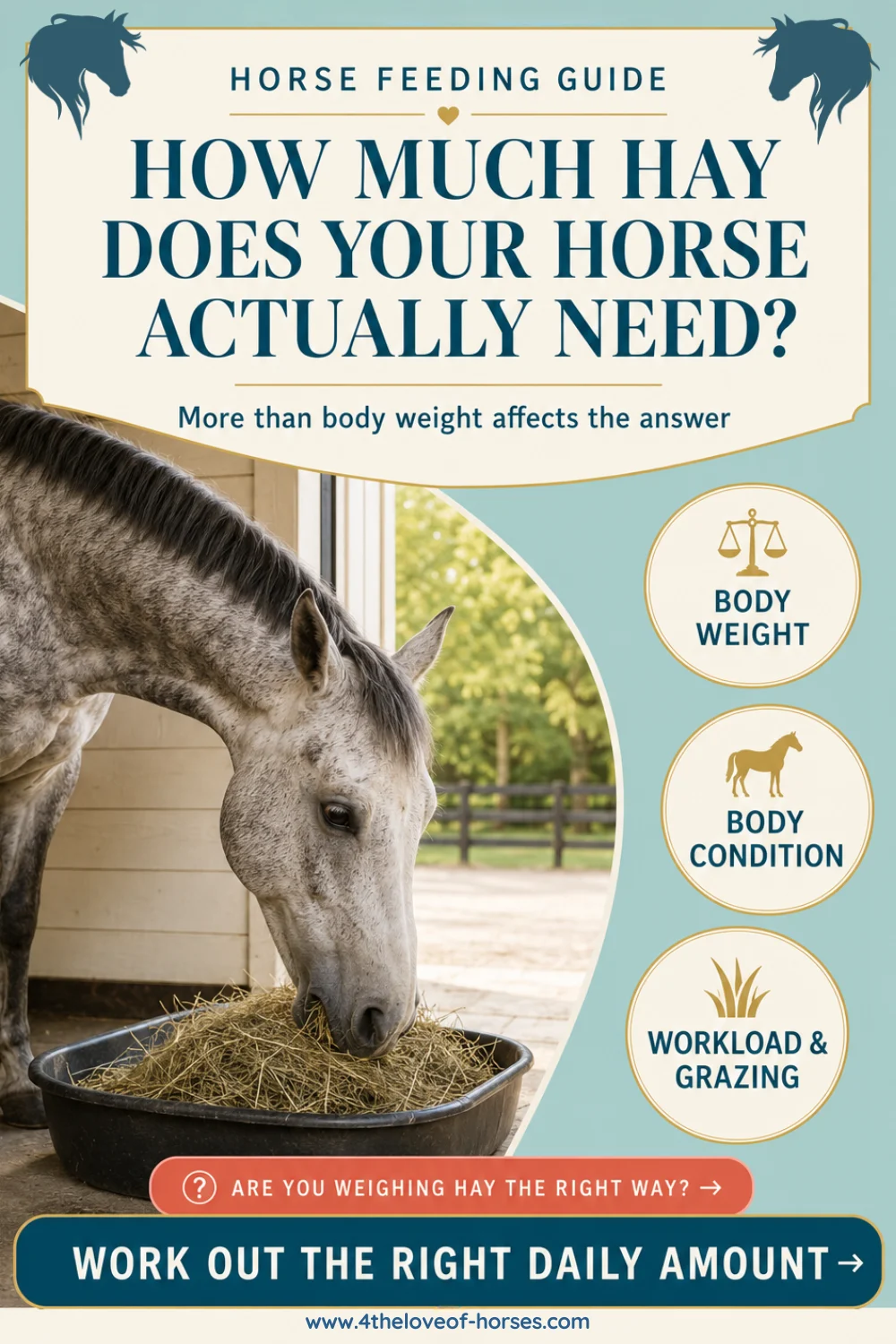
The standard recommendation is that horses should receive a minimum of 1.5% of their bodyweight in forage daily, with most horses doing better at 2% or above. This is dry matter weight — the weight of the hay itself, not the water content — and it is the floor, not the ceiling.
For a 500kg horse, 1.5% is 7.5kg of hay per day. Two percent is 10kg. Most people, when they weigh what they are actually providing rather than estimating by eye, find they are feeding significantly less than this — sometimes half the required amount — while simultaneously wondering why their horse is cribbing, losing topline, producing loose droppings, or showing signs of gut discomfort.
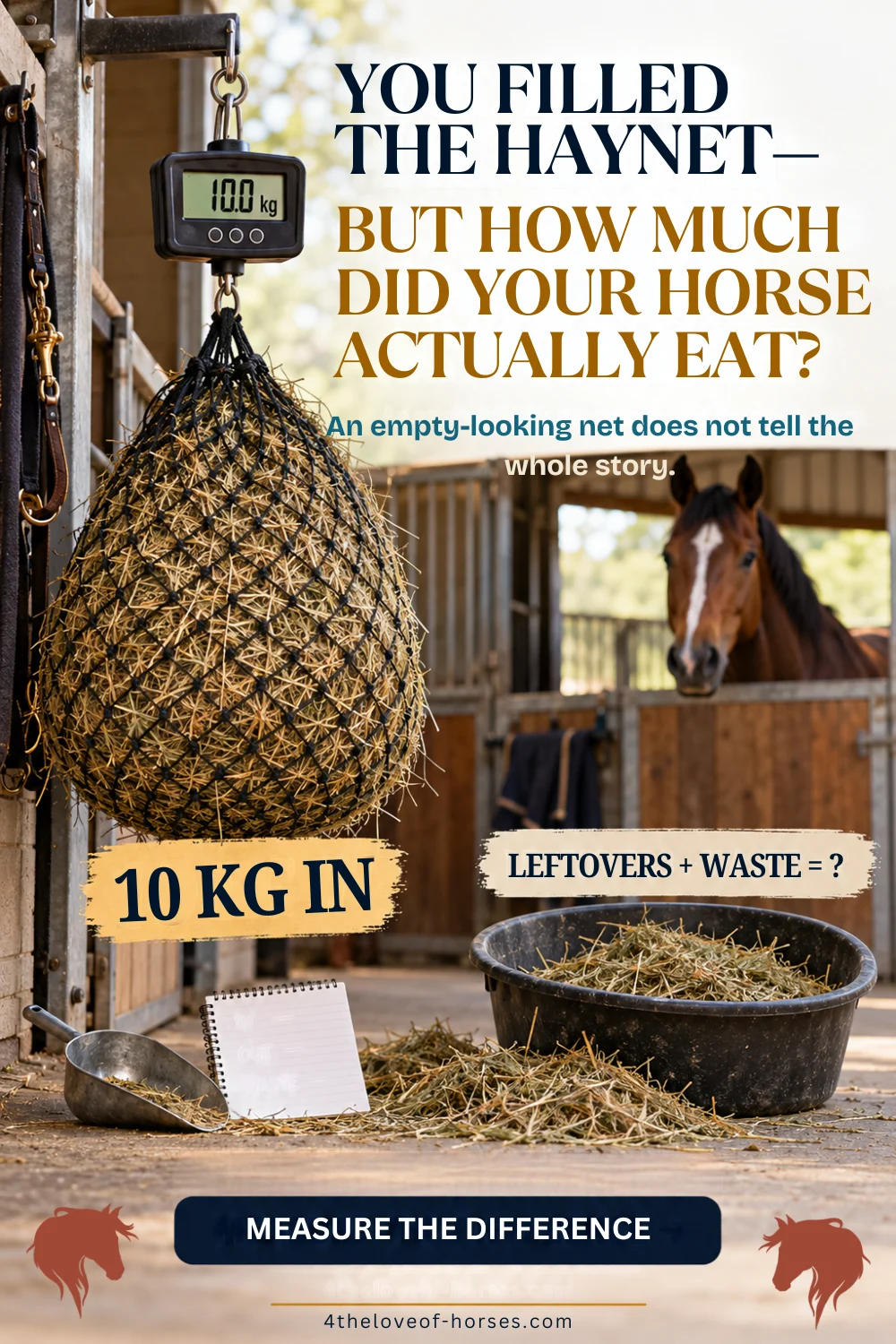
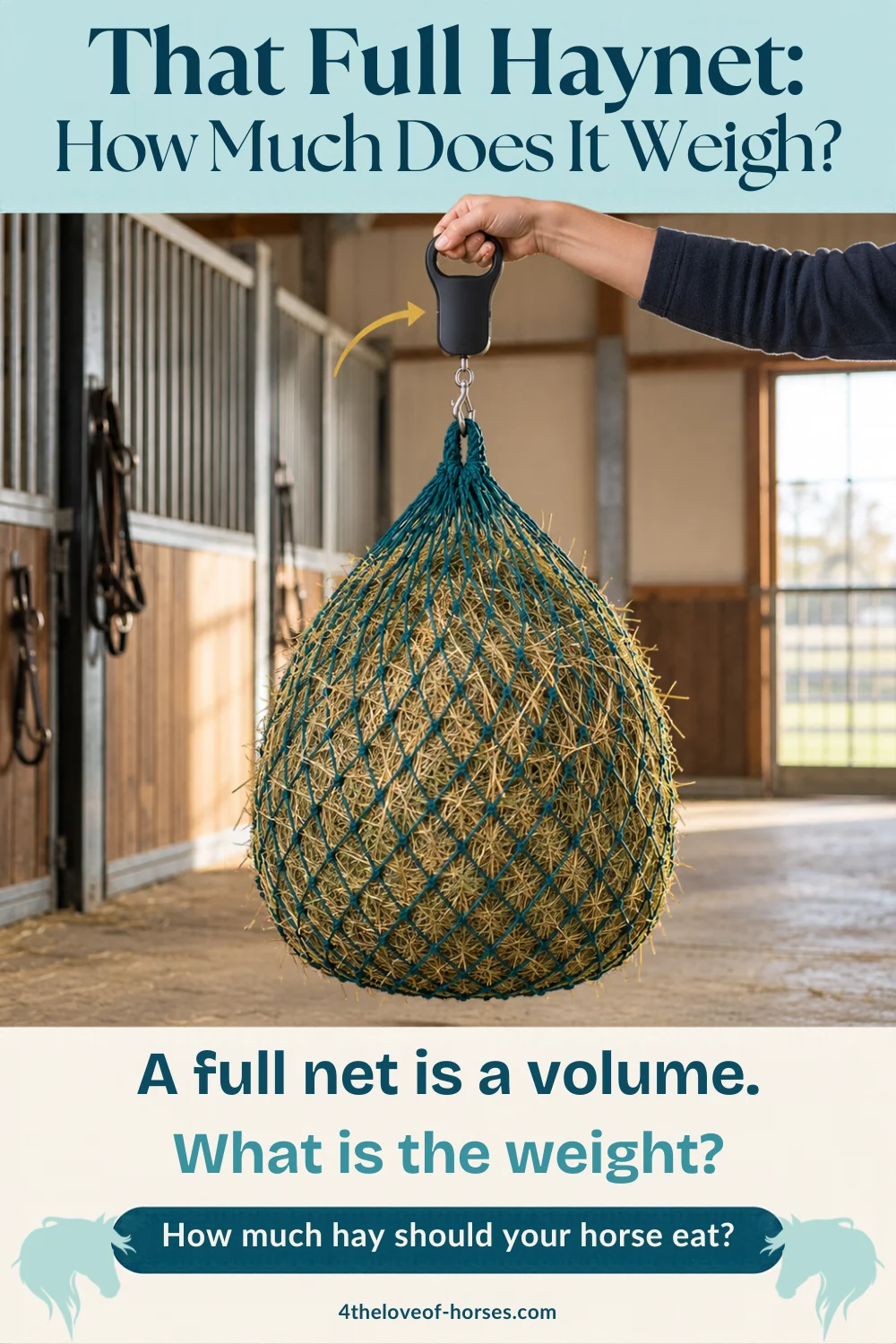
The most common mistake in hay feeding is estimating by volume rather than weight. A flake of hay that looks generous might weigh anywhere from 1.5kg to 4kg depending on how tightly it is compressed. A hay net that appears full might be 3kg or 8kg. You cannot assess hay intake accurately by looking at it. Weigh your hay. Use a simple luggage scale hung from a hook in your feed room — it takes ten seconds and immediately tells you whether your horse is receiving what they need.
Daily Hay Requirements by Bodyweight
Use this table as your starting point. These figures are for horses at maintenance — adjust upward for horses in work, breeding mares, growing youngstock, or veterans with reduced digestive efficiency.
| Horse Type | Bodyweight | Minimum (1.5%) | Recommended (2%) |
|---|---|---|---|
| Small pony | 200kg | 3 kg/day | 4 kg/day |
| Medium pony | 300kg | 4.5 kg/day | 6 kg/day |
| Large pony / cob | 400kg | 6 kg/day | 8 kg/day |
| Average horse | 500kg | 7.5 kg/day | 10 kg/day |
| Warmblood / sport horse | 600kg | 9 kg/day | 12 kg/day |
| Large warmblood / draft | 700kg | 10.5 kg/day | 14 kg/day |
| Figures are dry matter weight. Pasture grazing counts toward daily forage intake — deduct approximately 1–2kg per hour of good quality grazing. Horses in hard work, breeding stock and veterans typically need amounts at or above the 2% figure. | |||
If your horse has turnout on good quality pasture, that grazing counts toward their daily forage intake. A horse grazing well for six to eight hours on lush pasture may be meeting a significant portion of their requirement from grass alone. However pasture quality and quantity varies enormously — by season, rainfall, stocking density and grass species. In winter, during drought, or on overgrazed paddocks, pasture may provide almost nothing nutritionally. Never assume your horse is meeting their forage needs from pasture without assessing what is actually there.
6 Factors That Change How Much Hay Your Horse Needs
The bodyweight percentages above are a starting point. These six factors can shift the requirement significantly — sometimes by 30–50% above the maintenance figure.
Workload
Horses in regular moderate to hard work have significantly higher energy requirements. Forage should increase alongside work intensity — not just concentrate feed. A competition horse needs more of everything, and forage is the safest way to deliver that extra energy.
Weather and Season
Cold weather significantly increases a horse’s energy requirement for maintaining body temperature. The fermentation of forage in the hindgut generates heat — hay is your horse’s most efficient and natural central heating system. Increase hay in cold weather before reaching for extra hard feed.
Age
Veterans over 20 often have reduced digestive efficiency — they absorb less from what they eat, regardless of quantity. Senior horses frequently need more forage and better quality forage than younger horses, plus feeds that compensate for declining gut function. Forage intake should increase with age, not decrease.
Breeding and Lactation
Mares in the last trimester of pregnancy and especially those in early lactation have the highest nutritional requirements of any horse. Forage quality becomes critical — energy-dense haylage or alfalfa-mixed hay is often necessary alongside increased quantities to meet these demands.
Dental Health
A horse with dental problems cannot chew hay effectively, regardless of how much they are given. Long fibre strands pass through undigested, delivering far less nutritional value than the weight would suggest. Dental horses often need soaked hay, haylage, or hay replacer pellets to actually absorb what they are eating.
Body Condition
A horse that needs to gain weight requires more hay — ideally higher quality or energy-dense hay — alongside appropriate hard feed. A horse that needs to lose weight requires the opposite approach: lower-calorie hay (late-cut, mature grass hay) in adequate quantity, not restricted hay, which creates its own set of problems.
Adjustments by Life Stage and Situation
Not All Hay Is Equal — Understanding Hay Types
The amount of hay matters. But the type matters just as much. Feeding 10kg of poor quality hay to a horse with high nutritional requirements is not the same as feeding 10kg of good quality hay. Here is a quick guide to the most common hay types and their relative merits.
| Hay Type | Best For | Advantages | Cautions |
|---|---|---|---|
| Grass hay (mature) | Good doers, weight management, ad lib feeding | Low sugar and calorie content, good fibre, suitable for laminitics and IR horses | Lower nutritional value — hard workers and breeding stock need more or better quality alongside |
| Grass hay (early cut) | Maintenance horses, light work | Better nutritional profile than mature hay, good palatability, adequate protein | Higher sugar content than mature hay — monitor for good doers and laminitics |
| Alfalfa (lucerne) | Hard workers, underweight horses, mares, youngstock | High protein, high calcium, energy-dense, excellent palatability, good for topline | Rich — not suitable as the sole forage source for easy keepers; calcium:phosphorus ratio needs balancing |
| Haylage | Horses with respiratory issues, veterans, breeding stock | Low dust, high palatability, soft texture good for older teeth, higher moisture content supports hydration | Higher calorie density than hay — adjust quantities accordingly; must be fed fresh once opened |
| Mixed hay (grass + legume) | Most horses in light to moderate work | Better nutritional balance than pure grass hay, good palatability, versatile | Quality varies widely — know your supplier and consider hay analysis for best results |
If your horse is losing weight despite apparently adequate hay intake, or if you are struggling to balance a diet, a hay analysis will tell you exactly what your forage is providing in terms of energy, protein, sugar, fibre and mineral content. Many feed companies offer free analysis advice when you submit results, and the cost of analysis is far less than the cost of supplementing blindly. It takes the guesswork out of the foundation of your horse’s diet.
Signs Your Horse Is Getting Too Little — or Too Much
Signs of Insufficient Hay
- Wood chewing or crib-biting
- Eating bedding, soil or droppings
- Aggression or anxiety at feed time
- Weaving, box walking or stereotypies
- Loose or inconsistent droppings
- Recurring mild colic
- Gulping hard feed frantically
- Weight loss or poor topline
- Dull coat and poor condition
- Gastric ulcer signs
Signs of Too Much Rich Hay
- Unexplained weight gain
- Cresty neck or fat pads
- Laminitis or foot sensitivity
- High energy or excitability
- Loose droppings from rich haylage
- Muscle stiffness (tying-up risk)
- Insulin dysregulation signs
- Filled legs or poor circulation
How to Get Your Horse’s Hay Right — Practical Steps
Weigh your horse accurately
You cannot calculate the right amount of hay without knowing your horse’s bodyweight. Use a weightbridge if you have access to one. Otherwise a weigh tape gives a reasonable estimate, or use the standard formula: girth² × body length ÷ 11,900 (measurements in centimetres, result in kilograms). Check weight monthly and adjust hay accordingly.
Weigh your hay — every time until you know your portions
Hang a luggage scale in your feed room. Weigh sections, flakes or nets until you know exactly what each portion weighs. Once you know that your standard hay net weighs 4kg, you know that three nets equals 12kg. But re-weigh periodically — hay density varies between batches and between seasons.
Calculate your daily total including pasture
Add up all hay provided in 24 hours. If your horse has turnout, estimate pasture intake — roughly 1–2kg per hour of good grazing, less on sparse or winter pasture. Compare your total to the 1.5–2% bodyweight target. If you are below the minimum, address the gap before changing anything else.
Eliminate the overnight gap
If your horse is stabled at night, the most important change you can make is ensuring hay is available as close to continuously as possible. Use a slow feeder net to extend eating time — a horse that empties a standard net in 90 minutes may take four to six hours with a small-holed net. The target is no more than four hours without forage access.
Always feed hay before concentrates
Never feed hard feed into an empty stomach. Always provide hay 20–30 minutes before the concentrate meal so the stomach is not empty when the faster-fermenting feed arrives. This single change reduces acid splash, ulcer risk, and the frantic eating behaviour that comes from a horse fed concentrates when hungry.
Monitor body condition and adjust regularly
Hay requirements change with season, workload, age and the quality of each new batch of hay. Do a hands-on body condition assessment monthly — run your hands over the ribs, spine, hindquarters and neck crest. Adjust hay up or down based on what you feel, not just what you see. A thick coat disguises weight loss effectively until it is significant.
If I could give every horse owner one piece of nutritional advice, this would be it: weigh your hay and weigh your horse. Everything else flows from those two numbers. The owners who tell me their horse “gets plenty of hay” almost always discover, when they actually weigh it, that the reality is quite different from their estimate. And the horses whose conditions improve most dramatically, most reliably, with the least intervention — are almost always the ones whose owners simply increased and regulated their forage provision and let the horse’s digestive system do the rest.
Free Download: Horse Nutrition Calculator
Enter your horse’s details and get a personalised daily feeding plan — hay requirements, concentrate recommendations and nutritional guidance based on your horse’s weight, workload and life stage.
Use the Free Calculator →