
Horse Wound Care: A Complete Step-by-Step Guide From an Experienced Horse Owner

Anyone who has spent time around horses knows that injuries are not a matter of if but when. Horses are large, curious, powerful animals who share their world with barbed wire, gate latches, sharp branches, and other horses’ teeth. Over 45 years of working with horses, I have treated everything from tiny scrapes that barely broke the skin to deep lacerations that required emergency veterinary intervention and weeks of careful aftercare.
What I have learned through all of those experiences is that the first few minutes after discovering a wound can shape the entire healing journey. A calm, knowledgeable response prevents panic, reduces the risk of infection, and gives your horse the best possible chance of a full recovery. This guide brings together the practical, hands-on knowledge I wish someone had handed me when I first started — alongside the veterinary science that underpins every recommendation.
Understanding the Different Types of Horse Wounds
Before you can treat a wound effectively, you need to understand what you are looking at. Not all injuries are created equal, and the type of wound determines everything from the cleaning approach to whether you need a vet on-site within the hour.
Cuts and lacerations are the most common injuries I encounter. They are usually caused by fencing, metal edges on gates, or sharp objects hidden in the paddock. A clean cut from a piece of sheet metal looks very different from a jagged tear caused by barbed wire, and the jagged variety is almost always more prone to infection because the torn tissue creates pockets where bacteria can thrive. If the edges of the wound are smooth and can be brought together, there is a reasonable chance it can heal neatly — but if the skin is shredded or a flap is hanging loose, you are looking at a longer, more complex recovery.
Abrasions and scrapes tend to be superficial, caused by friction against rough surfaces such as arena fencing, stable walls, or the ground during a roll. They look alarming because they often cover a large area and weep fluid, but they are generally the least serious category of wound. The main risk is contamination from dirt ground into the raw skin.
Puncture wounds are the ones that worry me most. A nail, a thorn, a splinter of wood — the entry point can be surprisingly small, which makes puncture wounds easy to miss entirely. The real danger lies beneath the surface. A puncture can drive bacteria deep into tissue, and because the small opening tends to close over quickly, it can seal infection inside. Any puncture wound near a joint or on the sole of the hoof warrants an immediate call to your vet, no exceptions.
Contusions and bruises result from blunt force — a kick from another horse, a collision with a solid object, or a fall. You may not see broken skin at all, but the swelling, heat, and tenderness tell you that blood vessels and soft tissue underneath have been damaged. Cold hosing in the first 24 hours can make a significant difference to the level of swelling.
Sprains and strains affect ligaments, tendons, and muscles rather than the skin itself. They typically show up as lameness, localised swelling, and reluctance to bear weight. While they are not “wounds” in the traditional sense, they often accompany other injuries and require their own careful management.
How to Assess the Severity of a Wound
The moment you discover a wound on your horse, take a breath. Your horse will read your energy, and a calm handler makes for a calmer patient. Then work through a systematic assessment.
Look at the depth. Can you see muscle, tendon, or bone? If so, this is a veterinary emergency. Even if the wound looks deep but you cannot see underlying structures, err on the side of caution — a vet can assess whether suturing is appropriate and whether deeper damage has occurred.
Consider the location. Wounds over joints are always more serious than wounds on flat areas of the body, because there is a risk that the joint capsule has been penetrated. Synovial fluid leaking from a wound is a clear, slightly sticky liquid — if you see anything like that, call your vet immediately. Wounds on the lower legs are also tricky because there is very little soft tissue between the skin and the bone, blood supply is relatively poor, and the area is constantly exposed to dirt and moisture.
Evaluate the bleeding. Steady, dark red blood is venous and, while it can look dramatic, is usually controllable with direct pressure. Bright red blood that pulses with the heartbeat is arterial and requires urgent veterinary attention. Apply firm pressure with a clean pad and keep it there until help arrives.
Check for foreign objects. If you can see a nail, splinter, or piece of wire in the wound, resist the urge to pull it out unless it is sitting loosely on the surface. Deeply embedded objects can be plugging a blood vessel, and removing them without veterinary support can cause sudden, heavy bleeding.
Watch your horse’s behaviour. A horse that is sweating, trembling, has a rapid heart rate, or seems dull and unresponsive may be going into shock. This is a veterinary emergency regardless of how the wound itself looks.
When to Call the Vet — No Hesitation
There are situations where professional help is non-negotiable. Call your vet if you observe any of the following:
| Situation | Why It Matters |
| Wound is deep enough to see muscle or bone | Risk of structural damage; may need suturing |
| Wound is near or over a joint | Possible joint capsule penetration |
| Bleeding cannot be controlled with pressure | Possible arterial damage |
| Foreign object is deeply embedded | Removal requires sedation and veterinary skill |
| Puncture wound on the sole of the hoof | Risk of deep infection affecting internal structures |
| Eye injury of any kind | Eyes are delicate; even minor injuries can worsen rapidly |
| Horse shows signs of shock | Systemic emergency requiring IV fluids and medication |
| Wound is more than 6 hours old and gaping | Suturing window may be closing; vet needs to decide |
| Any wound you are unsure about | It is always better to call and be told it is minor |
Building Your Equine First Aid Kit
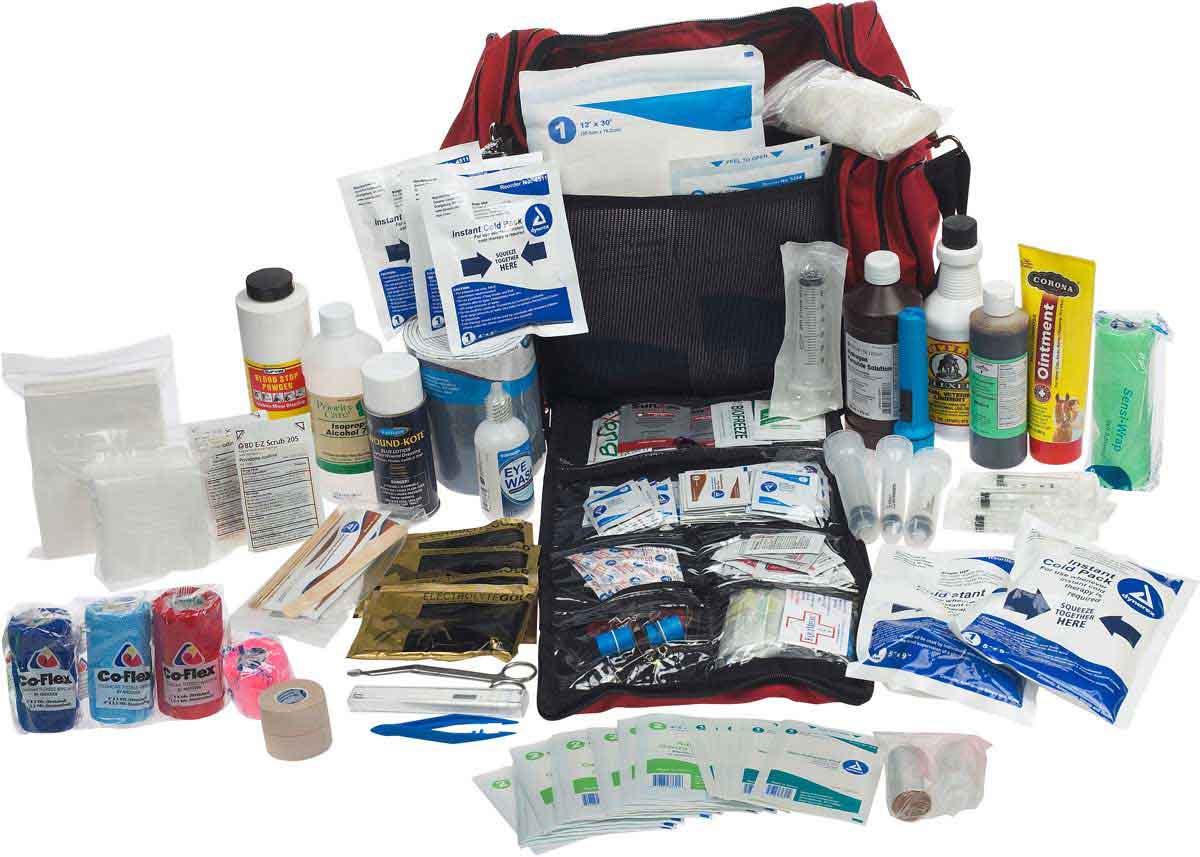
A well-stocked first aid kit is something you prepare before you need it. I keep one in the tack room and a smaller version in the horse trailer. Here is what should be in yours:
| Item | Purpose | Practical Tip |
|---|---|---|
| Sterile gauze pads (various sizes) | Cleaning and covering wounds | Buy in bulk — you will use more than you expect |
| Sterile saline solution | Flushing wounds gently | A large syringe (without needle) gives good flushing pressure |
| Veterinary antiseptic (e.g., dilute chlorhexidine or povidone-iodine) | Disinfecting wound edges | Dilute according to vet instructions — stronger is not better |
| Non-stick wound dressings (e.g., Melolin or Telfa pads) | Covering wounds without sticking | Essential for preventing painful dressing changes |
| Vet wrap (self-adhesive bandage) | Securing dressings | Do not stretch it tight — let it stick to itself naturally |
| Cotton wool or gamgee padding | Cushioning under bandages | Always use a padding layer between the wound and vet wrap |
| Adhesive tape | Securing bandage ends | Medical tape works better than duct tape in wet conditions |
| Curved bandage scissors | Cutting dressings and bandages safely | Rounded tips prevent accidentally cutting the horse |
| Clean tweezers | Removing surface debris | Sterilise with antiseptic before each use |
| Disposable gloves | Protecting you and the wound | Nitrile gloves are more durable than latex |
| Topical antibiotic cream (vet-recommended) | Preventing wound infection | Check the expiry date every six months |
| Digital thermometer | Monitoring for fever | Normal range for an adult horse is 37.5–38.5°C (99.5–101.3°F) |
| Torch/flashlight | Examining wounds in poor light | A head torch keeps both hands free |
| Clean towels | General-purpose cleaning and padding | Old towels work perfectly — just make sure they are clean |
| Your vet’s phone number | Obvious, but easy to forget in a panic | Tape it to the inside of the kit lid |
Step-by-Step Wound Cleaning
Once you have assessed the wound and determined that it is something you can manage (or while you wait for the vet to arrive for more serious injuries), proper cleaning is your most important task. The goal is to remove contamination without causing further damage to the tissue.
Step 1: Secure your horse. Have someone hold your horse, or tie them safely with a quick-release knot. A horse in pain can be unpredictable, so position yourself where you can move away quickly if needed. If the wound is on a hind leg, be especially mindful of your position.
Step 2: Put on gloves. This protects the wound from bacteria on your hands and protects you from any pathogens in the horse’s blood.
Step 3: Assess before you touch. Take a good look at the wound before you start cleaning. Note the size, depth, location, and whether there is active bleeding. If bleeding is significant, apply direct pressure with a clean pad for several minutes before attempting to clean.
Step 4: Flush generously with saline. Use a large syringe (60ml is ideal) to direct a steady stream of saline solution into and around the wound. The mechanical action of the fluid is what removes dirt and bacteria — you want enough pressure to dislodge debris but not so much that you drive contaminants deeper. I typically use at least 500ml of saline for a moderate wound.
Step 5: Gently clean the surrounding skin. Using dilute antiseptic on gauze, clean the skin around the wound. Work outward from the wound edges to avoid pushing dirt back in. If the hair around the wound is long and likely to fall into the wound, you can carefully clip it — but apply a water-soluble gel (like KY Jelly) over the wound first so the clipped hair sticks to the gel rather than falling into the wound. This is a trick I learned from a vet years ago and it works brilliantly.
Step 6: Pat dry gently. Use clean, sterile gauze to pat the wound and surrounding area dry. Do not rub — rubbing damages the fragile new tissue that is already beginning to form.
Step 7: Apply topical treatment. If your vet has recommended a specific wound cream or spray, apply it now according to their instructions. For fresh, clean wounds, a thin layer of veterinary antibiotic ointment is usually appropriate.
A note on what NOT to use: Avoid hydrogen peroxide on open wounds. While it fizzes impressively and feels like it must be doing something, it actually damages healthy cells and can slow healing. Similarly, avoid neat (undiluted) antiseptic solutions — they are designed to be diluted, and full-strength application can burn tissue.
Bandaging: When, Why, and How
Not every wound needs a bandage. Small, superficial scrapes on the body often heal better when left open to the air, provided the horse is in a clean environment and flies are controlled. However, wounds on the lower legs almost always benefit from bandaging because the area is prone to contamination, swelling, and the development of proud flesh (excessive granulation tissue).
The layering principle is essential. A proper equine bandage has three layers:
The primary layer sits directly against the wound. This should be a non-stick dressing — never place cotton wool or gauze directly on a raw wound, as it will stick and tear new tissue when you remove it.
The secondary layer provides padding and absorbs any fluid. Gamgee tissue or cotton wool rolled around the leg serves this purpose. This layer should be even and smooth, with no wrinkles or bunching that could create pressure points.
The outer layer holds everything in place. Vet wrap is the standard choice. Apply it firmly enough to stay put but not so tightly that it restricts circulation. A good test: you should be able to slide a finger under the top edge of the bandage. If you cannot, it is too tight.
Check the bandage twice daily. Look for slipping, swelling above or below the bandage, heat, odour, or any sign that the horse is more uncomfortable than before. A bandage that has slipped and bunched around the fetlock can cause serious pressure damage surprisingly quickly.
Change the dressing as your vet advises. In the early stages of healing, daily changes may be necessary. As the wound progresses, you may be able to extend this to every two or three days. Each time you change the dressing, clean the wound again and assess its progress.
Recognising and Preventing Infection
Infection is the single biggest threat to wound healing, and catching it early makes an enormous difference to the outcome. Here are the signs to watch for:
Increased swelling and heat around the wound after the first 48 hours. Some initial swelling is normal, but if it is getting worse rather than better after the second day, infection may be setting in.
Changes in discharge. A small amount of clear or slightly yellow fluid is normal in the early stages. Thick, cloudy, green, or foul-smelling discharge is a red flag.
Redness spreading outward from the wound edges. A thin ring of pink is normal healing; angry red streaks radiating away from the wound suggest the infection is spreading.
Your horse developing a fever. If the temperature rises above 38.5°C (101.3°F), combined with any of the above signs, call your vet.
Behavioural changes. A horse that was coping well but suddenly becomes dull, goes off its feed, or seems more painful may be fighting an infection.
To prevent infection in the first place, keep the wound clean, change dressings regularly, ensure the horse’s environment is as clean as possible, and control flies aggressively during warmer months. Fly masks, fly sheets, and topical repellents are all part of your wound management toolkit during summer.
The Proud Flesh Problem
Proud flesh — or exuberant granulation tissue — is one of the most common complications of lower leg wounds in horses. It occurs when the body produces too much of the pink, bumpy tissue that normally fills a wound during healing. Instead of the skin growing across the wound to close it, the granulation tissue grows above the level of the surrounding skin, creating a raised, raw mass that bleeds easily and prevents the wound from closing.
Horses are particularly prone to proud flesh on the lower legs because the blood supply is strong but the skin is tight, and there is constant movement of the underlying tendons and joints. If you notice the wound tissue rising above the level of the skin edges, contact your vet. Treatment may involve trimming the excess tissue (which is not painful for the horse, as granulation tissue has no nerve endings), applying a steroid cream to reduce growth, or adjusting the bandaging technique.
Prevention is better than cure: keeping the wound appropriately bandaged with gentle, even pressure can help control granulation tissue growth. Some vets also recommend specific wound gels that discourage excessive granulation while still supporting healthy healing.
Monitoring the Healing Journey
Wound healing in horses is not a straight line. There will be days when the wound looks markedly better and days when it seems to have taken a step backward. This is normal, and patience is essential.
Keep a simple healing journal. Each time you change the dressing, note the date, the size of the wound (a quick photo on your phone is even better), the colour and amount of any discharge, and how the horse is behaving. Over the course of a week, these notes will reveal the overall trend far more reliably than any single observation.
Signs that healing is progressing well include a gradual reduction in wound size, healthy pink granulation tissue that is level with or slightly below the skin surface, decreasing discharge, the appearance of new skin growing in from the wound edges, and a horse that is comfortable and behaving normally.
Signs that something may be wrong include a wound that is not getting smaller after two weeks, increasing discharge or a change in its character, proud flesh growing above the skin level, the horse becoming more lame or painful, or any of the infection signs described above.
Do not hesitate to send your vet a photo if you are unsure whether the wound is progressing as it should. Most equine vets are happy to review a photo and advise whether an in-person visit is needed.
Special Considerations by Body Part
Different areas of the horse’s body present different challenges for wound management.
Lower leg wounds are the most demanding. Poor blood supply, constant movement, proximity to the ground, and the tendency toward proud flesh all conspire against you. These wounds almost always need bandaging, and healing times can be measured in weeks or months rather than days.
Wounds near joints require immediate veterinary assessment. If the joint capsule has been penetrated, the horse needs aggressive treatment — often including joint lavage (flushing) and intravenous antibiotics — to prevent a life-threatening joint infection.
Face and head wounds tend to bleed dramatically because the head has an excellent blood supply. The good news is that this same blood supply promotes rapid healing. The challenge is keeping dressings in place on a horse that rubs its head on everything. Fly masks can sometimes double as a way to hold a dressing over a forehead wound.
Hoof and sole wounds are a specialised area. A puncture to the sole of the hoof can potentially reach the coffin bone, the navicular bursa, or the deep digital flexor tendon sheath — all of which are serious. If your horse steps on a nail, do not pull it out. Call your vet, who may want to X-ray the hoof with the nail still in place to see exactly which structures are involved.
Wounds on the body (barrel, shoulder, hindquarters) generally heal well because there is good blood supply and plenty of soft tissue. These are often the wounds you can manage confidently at home, provided they are not deep enough to require suturing.
Building Your Confidence
Wound care is a skill that improves with practice, and every horse owner should invest time in learning the basics before an emergency forces them to learn on the fly. Consider attending an equine first aid course — many veterinary practices and equestrian organisations offer them. Practice bandaging on a calm, healthy horse so that the technique feels natural when you need it under pressure.
Most importantly, build a relationship with your vet. A vet who knows you and your horses can give better advice over the phone, is more likely to talk you through a situation calmly, and will know when something genuinely needs their hands-on attention versus when you can manage at home with guidance.
Wound care is not glamorous, and it is rarely convenient. But there is a deep satisfaction in watching a wound you have carefully tended close over and heal, knowing that your knowledge and dedication made the difference. That is what being a horse person is all about.
further reading
How To Help Horse Wounds Heal Move your horse to a safe place to limit further injury and keep him quiet. · Use clean towels to apply direct pressure if the wound is actively bleeding.
Wound Management | Rossdales Veterinary Surgeons› Routine Stable VisitsThe best solution for irrigation is sterile saline with or without dilute antiseptics. If you can do it safely without further injuring the horse, or yourself, …
Have you dealt with a tricky wound on your horse? I would love to hear your experiences — drop me a message through the enquiry page or connect with me on Pinterest.
For more horse care guides, visit the Resources page.