10 Signs Your Horse Needs the Vet Right Now — Don’t Wait

Knowing when to call the vet is one of the most important skills a horse owner can have. Horses are stoic animals — they often mask pain and discomfort until a problem is quite advanced, which means by the time you notice something is wrong, you may have less time than you think.
Some of these signs mean call right now, stop reading and pick up the phone. Others mean monitor closely and call within the hour. I’ll tell you which is which for each one.
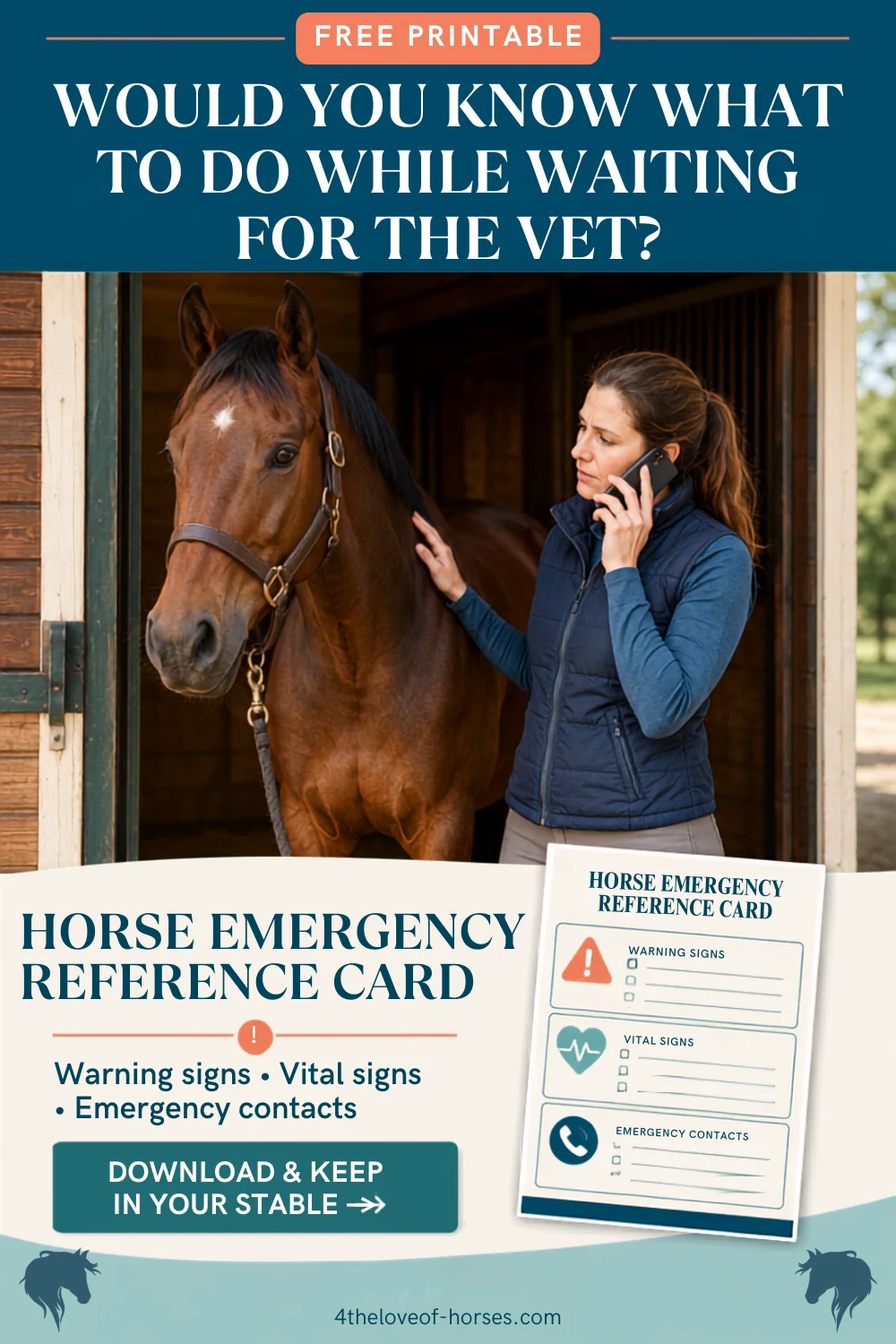
I’ve also created a free printable Emergency Reference Card you can download at the end of this post — designed to go on your feed room wall so you have this information when you need it most, not somewhere in a browser tab.
🚨 Free Download — Emergency Reference Card
A printable single-page reference card for your feed room wall. Includes all 10 warning signs, your horse’s normal vital signs (with spaces to fill in their individual baseline), emergency contacts, and a “while you wait for the vet” checklist.
GET THE FREE REFERENCE CARD →First: Know Your Horse’s Normal Vitals
Before we get into the warning signs, this matters enormously — you can only recognise abnormal if you know what normal looks like for your specific horse. Take these readings on a calm, healthy day and write them down. Your horse’s baseline may differ slightly from the averages.
| Vital Sign | Normal Range (Adult Horse) | How to Check |
|---|---|---|
| Temperature | 37.2°C – 38.3°C (99°F – 101°F) | Rectal thermometer, hold for 60 seconds |
| Heart rate / pulse | 28 – 44 beats per minute | Stethoscope on left side behind elbow, or press fingers to the facial artery under the jaw |
| Respiration | 8 – 16 breaths per minute | Watch the flank rise and fall, count for 30 seconds and double it |
| Gum colour | Pale pink, moist | Lift the upper lip and look at the gums above the front teeth |
| Capillary refill | Under 2 seconds | Press your thumb firmly on the gums, release — colour should return in under 2 seconds |
| Gut sounds | Gurgling on both sides | Press your ear (or a stethoscope) to the belly, both left and right sides |
10 Signs Your Horse Needs the Vet Right Now
Signs of Colic — Any Signs At All
Colic is the number one cause of death in horses, and it can escalate from mild discomfort to a life-threatening surgical emergency in a matter of hours. There is no such thing as a “wait and see” colic. Call your vet at the first sign.
Signs include: pawing at the ground, looking at or biting at the flank, repeatedly lying down and getting up, rolling (especially violently), refusing food, sweating without exercise, kicking at the belly, stretching out as if to urinate without doing so, or simply standing looking dull and uncomfortable.
Difficulty Breathing or Abnormal Breathing Sounds
A healthy horse at rest breathes quietly and effortlessly. Flared nostrils, laboured breathing, an unusually high respiratory rate (above 20 breaths per minute at rest), or any wheezing, rattling, or gurgling sounds from the airways or chest are all serious warning signs.
This can indicate severe heaves (COPD), pneumonia, a throat abscess, or in rare cases a ruptured airway — all of which require urgent veterinary attention.
Eye Injuries or Sudden Changes to the Eye
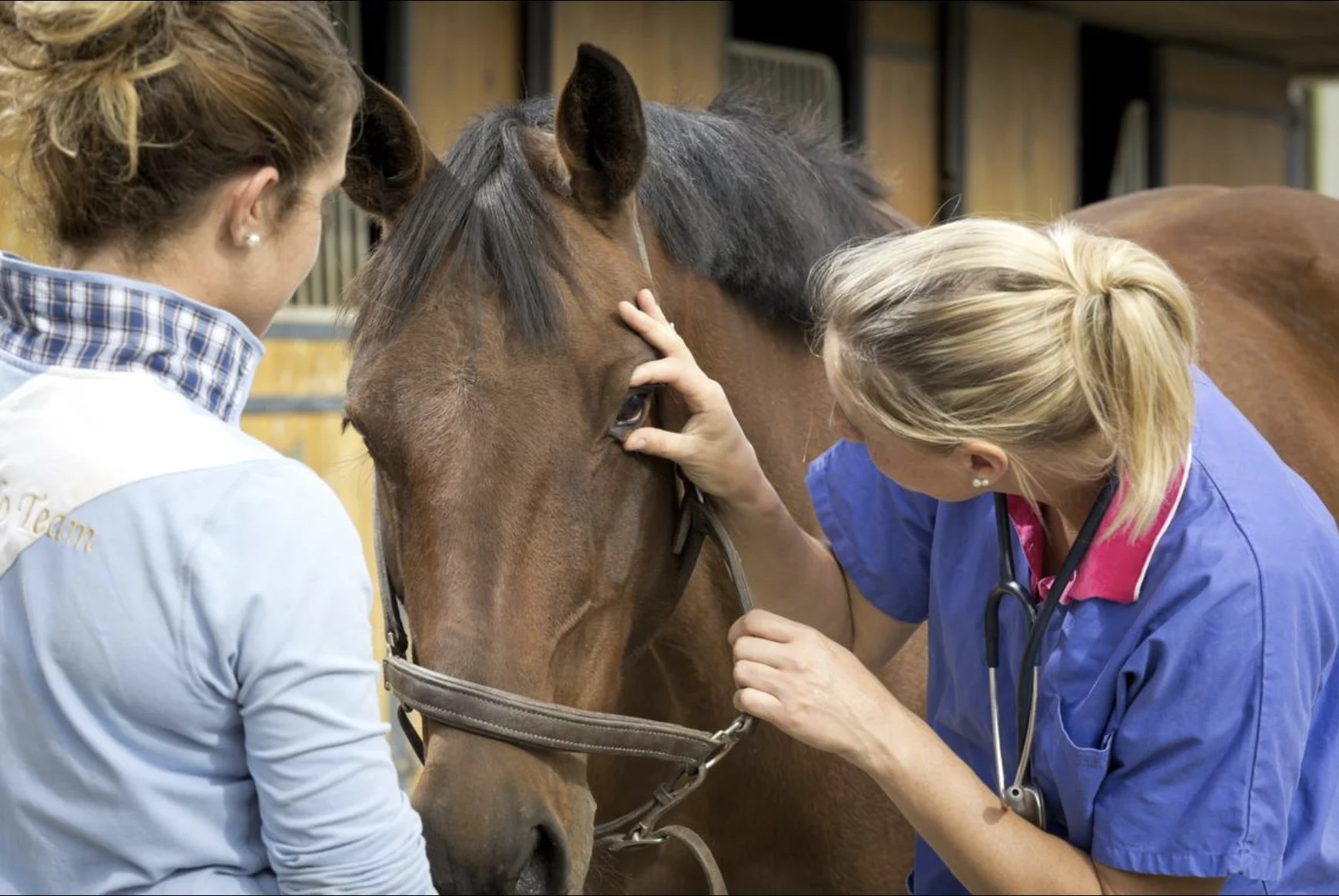
The eye is one of the fastest-deteriorating structures in a horse’s body when injured or infected. What looks like a minor scratch on the cornea in the morning can become a serious, sight-threatening ulcer by evening if untreated. Horses are also remarkably good at hiding early eye discomfort.
Call your vet for: a closed or squinting eye, excessive tearing or discharge, cloudiness or colour change in the eye, visible injury to the eye surface, or swelling around the eye socket. Do not wait to see if it improves.
Choke — Food Stuck in the Oesophagus
Unlike human choking which affects the airway, equine choke is a blockage in the oesophagus (food pipe). Horses can still breathe, but it’s extremely distressing and can lead to aspiration pneumonia or oesophageal damage if not cleared quickly.
Signs include: food and saliva draining from both nostrils, distress or stretching the neck, repeated swallowing attempts, coughing with food material coming up, and complete refusal to eat or drink.
Wounds That Are Deep, Won’t Stop Bleeding, or Are Near a Joint
Not every wound needs an emergency call — horses are remarkably good at collecting superficial scrapes. But certain wounds are immediately serious: any wound near a joint (the horse’s legs are full of them), any wound that is deep or has penetrated muscle, any wound with bone visible, any puncture wound (especially on the foot), or any wound that won’t stop bleeding after 10 minutes of firm pressure.
Joint infections are life-threatening and can develop from contamination in a matter of hours. If a wound is within 5cm of a joint, treat it as an emergency until proven otherwise.
Sudden or Severe Lameness
A horse that was sound yesterday and is suddenly three-legged lame today has something serious going on. This could be a fracture, a severe abscess, laminitis, a tendon or ligament injury, or a joint infection. All of these require veterinary assessment — and some of them, like a fracture or acute laminitis, require immediate attention.
Never assume sudden severe lameness is “just an abscess” without veterinary confirmation, especially if the horse is not weight-bearing at all. A horse unwilling to put any weight on a leg is in serious pain.
📋 Download the Free Emergency Reference Card
Print this and stick it in your feed room — all 10 signs, your horse’s vital sign spaces, emergency contacts, and what to do while you wait for the vet. All on one page.
DOWNLOAD FREE NOW →High Temperature (Fever)
A temperature above 38.5°C (101.3°F) in a horse at rest indicates the body is fighting something — infection, virus, or a significant inflammatory response. Temperatures above 39.5°C (103°F) are a genuine emergency. Horses with fever are often dull, off their feed, may be shivering, and will have elevated heart and respiratory rates.
Fever in a horse is never a “wait until morning” situation. The underlying cause needs to be identified quickly — equine influenza, strangles, viral respiratory infections, and pleuropneumonia can all deteriorate rapidly.
Abnormal Gum Colour or Prolonged Capillary Refill
Your horse’s gums are one of the best windows into their circulatory health. Pale pink and moist is normal. Any deviation from this warrants an immediate call to your vet.
White or very pale gums: significant blood loss, severe shock, or anaemia. Bright red or dark red gums: endotoxaemia, septicaemia, or severe infection. Bluish or purple gums: oxygen deprivation — an emergency. Yellow-tinged gums: liver disease or haemolytic anaemia. Dry, tacky gums with slow capillary refill (over 2 seconds): dehydration or poor circulation.
Neurological Signs — Stumbling, Head Tilt, Circling, Collapse
Neurological signs in a horse are always serious and always require immediate veterinary attention. These include: stumbling or falling with no obvious physical cause, a persistent head tilt, walking in circles, apparent blindness, muscle tremors or weakness, inability to coordinate limbs, or collapse.
Possible causes include equine herpesvirus (EHV-1), wobbler syndrome, EPM, head trauma, botulism, or liver disease — some of which are contagious and all of which require urgent diagnosis.
Retained Placenta in a Mare After Foaling
A mare should pass her placenta within 1–3 hours of foaling. This one is specifically for breeders — if your mare has not passed the placenta within 3 hours, call your vet. Do not wait. Do not pull it. Do not attempt to remove it yourself.
Retained placenta leads to uterine infection and endotoxaemia rapidly. A mare with a retained placenta can go from apparently fine to critically ill in 12–24 hours. It is one of the true postfoaling emergencies and one that is frequently underestimated.
⚠️ A note on pain relief: Many horse owners keep bute (phenylbutazone) or Banamine in the barn for emergencies. These can be appropriate in some situations, but always speak to your vet before administering — masking pain can hide critical symptoms, and some medications can be dangerous in cases of dehydration or kidney stress. When in doubt, call first.
What to Have Ready When You Call Your Vet
Your vet can help you far more effectively over the phone if you have this information ready:
- Your horse’s current vital signs — temperature, heart rate, respiratory rate, gum colour, capillary refill
- When you first noticed something wrong
- What has changed since then — better, worse, or the same
- When your horse last ate and drank normally
- When they last passed manure (and what it looked like)
- Any medications or treatments you’ve already given
- Your horse’s age, breed, weight, and any known health conditions
🚨 Download Your Free Emergency Reference Card
A printable one-page reference card designed for your feed room wall. Includes all 10 warning signs at a glance, a vital signs table with spaces to record your horse’s individual baseline, an emergency contacts section, and a step-by-step “while you wait for the vet” checklist.
Already have the reference card? You might also want the full Horse First Aid Kit Checklist — a complete guide to every supply you need in your barn before an emergency happens.
GET THE FREE REFERENCE CARD →