10 Signs Your Horse Needs a Dentist

Don’t Wait for the Annual Check
Your horse’s mouth affects everything: his weight, his behaviour, his gut health, and his way of going under saddle. Here’s what to look for between vet visits.
Most horse owners think about dental care once a year, when the equine dentist comes around. But a horse’s mouth can cause serious problems — weight loss, colic, resistance under saddle, choke, and chronic pain — long before that next scheduled visit. The difficulty is that horses are masters at hiding discomfort, and many of the signs of dental problems look exactly like training issues or digestive problems.
After 45 years working with horses, I can tell you that dental pain is one of the most underdiagnosed causes of poor condition and difficult behaviour I’ve seen. And it’s one of the most fixable — once you know what you’re looking at.
Here are the 10 signs that tell you your horse needs a dentist sooner rather than later.
Why Dental Health Matters More Than You Think
A horse’s teeth are unlike any other animal’s. They erupt continuously throughout life — horses are born with most of their teeth already developing in the jaw — and they’re designed to grind fibrous grass for up to 18 hours a day. When something goes wrong with even one tooth, the ripple effect through the whole mouth, and through the whole horse, can be significant.
- Sharp enamel points form on the outer edges of upper cheek teeth and inner edges of lower cheek teeth as a horse ages. These cut the cheeks and tongue, causing pain with every mouthful.
- Wave mouth, step mouth, and hooks develop when teeth don’t wear evenly — often due to conformation, missing teeth, or uneven chewing caused by pain elsewhere in the mouth.
- Retained caps (baby teeth that don’t shed cleanly) cause pain and prevent adult teeth from erupting correctly — common in horses aged 2½ to 4½.
- Periodontal disease causes pockets around the roots where food packs in and rots — extremely painful and often missed without a proper dental exam.
- Incomplete chewing means larger fibre particles reach the hindgut, disrupting fermentation, reducing nutrient absorption, and significantly increasing impaction colic risk.
“I’ve seen horses improve overnight after a dental visit — horses that had been labelled problem horses for years. The mouth is the first place I look when something isn’t right.”
The 10 Signs Your Horse Needs a Dentist
Some of these signs are obvious. Others are the quiet ones that build slowly over weeks or months — easy to attribute to other causes, easy to miss until you know what you’re looking for.
-
1
Quidding — dropping partially chewed food If you find balls of semi-chewed hay or grass on the stable floor, or notice your horse dropping food from his mouth while eating, this is one of the clearest signs of dental pain. It means chewing is hurting him, so he’s stopping mid-process and spitting out what he can’t manage. Don’t dismiss it as fussiness — it’s discomfort.
-
2
Weight loss despite eating well This is one of the most common — and most frustrating — presentations of dental problems. Your horse is eating, he seems to have enough feed, but he just won’t hold condition. The reason is that incomplete chewing means incomplete digestion. The fibre particles are too large for the hindgut to ferment efficiently, and nutrients pass through without being absorbed. If your horse is losing weight and you’ve ruled out worming, ulcers, and feed quality, his teeth are the next place to look.
-
3
Long fibre or whole grain in the manure Take a close look at your horse’s droppings. Are there long strands of hay, or whole oat or maize kernels passing through undigested? This is a direct sign that chewing is incomplete. Food that isn’t chewed properly can’t be properly fermented in the hindgut — what goes in whole comes out whole. It also means your feed costs are going straight into the muck heap.
-
4
Slow eating or reluctance to eat hard feed A horse that lingers over his feed, eats very slowly, or leaves concentrate feed he normally enjoys may be finding eating painful. Some horses will happily eat soft grass or hay but struggle with harder pellets or grain that require more vigorous chewing. Others show a sudden change in feed preference — if your horse has always eaten enthusiastically and suddenly seems disinterested, dental pain is high on the list.
-
5
Tilting the head to one side while eating Horses chew in a broad, lateral grinding motion. If one side of the mouth is painful, a horse will unconsciously favour the comfortable side — leading to a visible tilt of the head while chewing, or a tendency to always chew on the same side. Over time, this uneven wear creates more dental problems, compounding the original issue.
-
6
Choke — call your vet immediately if you suspect this Choke in horses is an oesophageal blockage rather than an airway blockage, but it is a veterinary emergency regardless. It often presents as food and saliva dribbling from the nostrils, distress, extended neck, and repeated swallowing attempts. One of the leading causes of recurrent choke is poor dental health — food that isn’t chewed properly forms larger boluses that are more likely to become stuck. If your horse has choked once, dental assessment is essential.
-
7
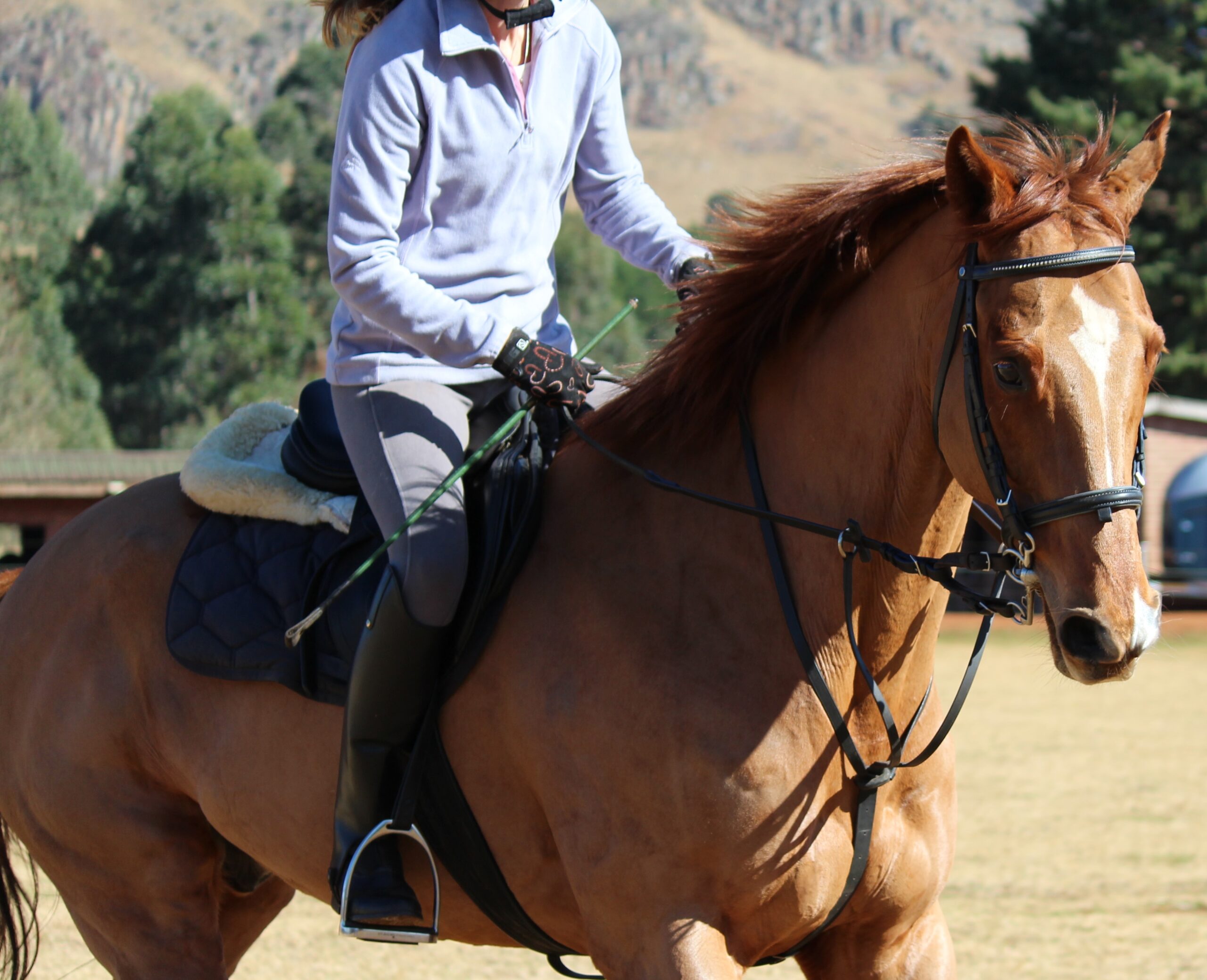
Resistance to the bit — head tossing, leaning, or one-sidedness Sharp enamel points and wolf teeth are the two most common dental causes of bit resistance. When the bit puts pressure on the cheeks or gums, a horse in dental pain will try to avoid or escape that pressure — through head tossing, leaning on one rein, refusing to go on the bit, hollowing, or becoming inconsistently contact-shy. Many horses labelled as “strong”, “heavy in the hand”, or “resistant” are simply in pain. Before addressing any bitting or training issue, rule out dental pain first.
-
8
Facial swelling or discharge from the nostrils Swelling along the jaw or cheekbones, or a persistent one-sided nasal discharge (especially if it has an unpleasant odour), can indicate a dental abscess, infected root, or sinusitis caused by an upper tooth problem. The roots of the upper cheek teeth sit in close proximity to the sinuses — a serious dental infection can drain directly into the sinus cavity. These signs warrant urgent veterinary attention, not just a dental visit.
-
9
Foul smell from the mouth or nostrils A healthy horse’s breath isn’t fragrant, but it shouldn’t be offensive. A strong, unpleasant odour from the mouth or a one-sided nasal discharge with an unpleasant smell suggests rotting food packed into periodontal pockets, a tooth root abscess, or necrotic tissue. This is not something to wait on — call your vet or equine dentist promptly.
-
10
Recurrent impaction colic If your horse has had more than one impaction colic without a clear dietary or management cause, add poor dental health to your investigation list. Improperly chewed fibre reaches the colon in larger particles, is harder to pass through the gut’s tight bends, and significantly increases the risk of blockage. It’s one of those connections that’s easy to miss — the colic looks like a gut problem, and it is, but the root cause is in the mouth.
Red flag signs (numbers 6, 8, and 9) warrant calling your vet rather than waiting for the next dental visit. Choke, facial swelling, and foul odour from the mouth or nose can indicate conditions that need veterinary assessment — not just a routine float.
How Often Should Your Horse See an Equine Dentist?
The “once a year” rule is a starting point, not a hard-and-fast standard. Different horses need dental care at very different intervals depending on their age, breed, diet, and dental history.
📅 Recommended Dental Check Frequency by Age
Equine Dentist vs Vet — Who Should You Call?
In many countries, routine dental floating and rasping can be performed by a qualified equine dental technician (EDT). However, any dental procedure that involves sedation, tooth extraction, or treatment of infection must be performed by a veterinarian. If you’re seeing any of the red flag signs above — swelling, foul odour, choke — call your vet first.
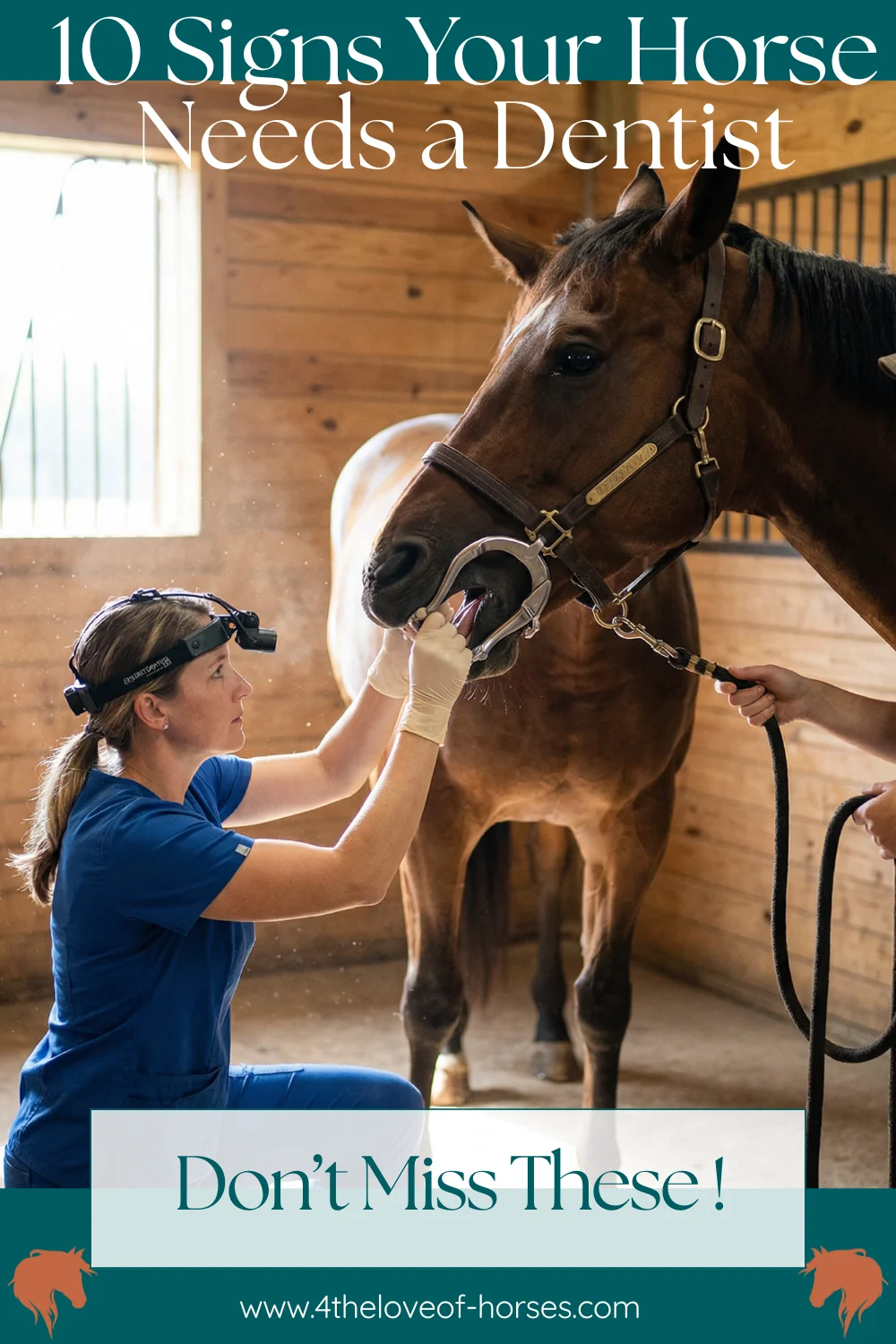
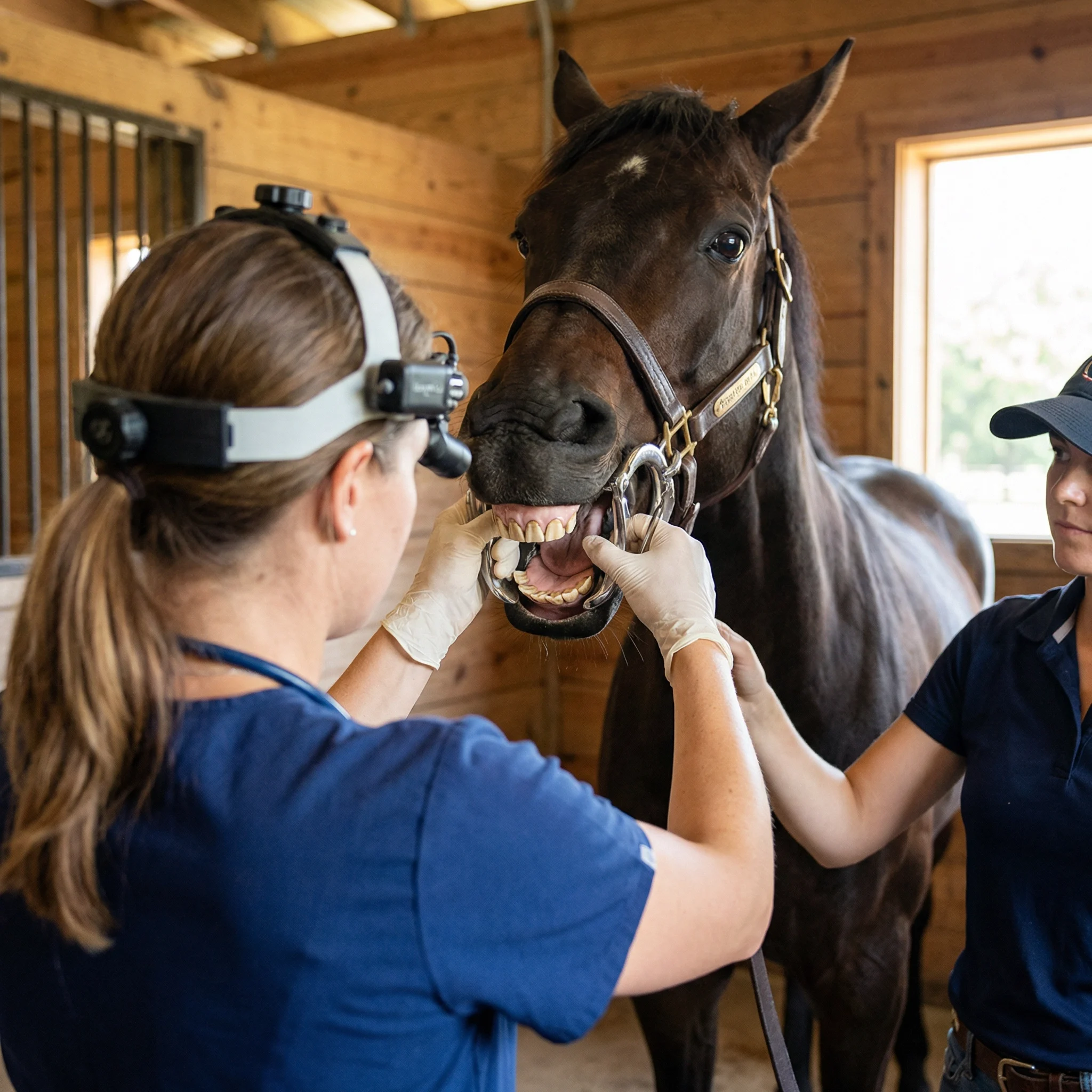
For routine checks, a good equine dental technician who works regularly with horses is often excellent value. Ask your vet for a recommendation, and make sure whoever you use has formal qualifications and works with a headtorch and mouth speculum — a proper dental exam without these is simply not thorough enough.
“Always ask to see your horse’s mouth yourself after a dental visit. A good equine dentist will show you exactly what they found and what they did. You’ll learn something every time.”
What Happens at a Dental Appointment?
Knowing what to expect helps you assess whether your horse is getting a thorough check — and helps you explain what you’ve been observing to the dentist.
- 1History and observation. The dentist will ask about your horse’s behaviour, eating habits, ridden work, and any signs you’ve noticed. Tell them everything — even things that seem unrelated.
- 2External examination. Checking the jaw, facial symmetry, lymph nodes, and any swelling or asymmetry before looking inside.
- 3Internal examination with speculum and headtorch. The mouth speculum holds the mouth open safely. Without it, a thorough check of the back teeth is not possible — the horse’s mouth is much longer than it looks.
- 4Floating (rasping). Removal of sharp enamel points and correction of uneven wear using hand floats or motorised equipment.
- 5Sedation if needed (vet only) for horses that are uncomfortable, for more involved work, or for young horses having their first examination.
- 6Debrief and follow-up plan. You should receive a clear explanation of what was found, what was done, and when to book the next visit.
Supporting Good Dental Health Between Visits
There’s genuinely a lot you can do between dental checks to support your horse’s mouth.
- ◆Maximise forage time and grass accessNatural grazing involves a wide range of head positions and lateral jaw movement that promotes even tooth wear. Horses that eat only from haynets or hay racks — with the head raised — wear their teeth differently and often develop more uneven surfaces.
- ◆Feed hay on the ground where possibleGround-level feeding encourages the natural head-down posture of grazing, which promotes better drainage and more natural jaw movement during chewing.
- ◆Know your horse’s manure baselineRegular observation of droppings is one of the easiest ways to catch dental deterioration early. If you start noticing long fibre or whole grain, you’ll catch the problem before it escalates.
- ◆Watch body condition carefullyWeigh or condition score your horse regularly. A horse whose score is declining despite adequate feed needs investigation — and dental health should be on the checklist.
- ◆Note any changes in ridden behaviourNew resistance, inconsistency on one rein, or sudden contact issues should prompt a dental check before a training intervention. Rule out pain first, always.
- ◆Keep your dental recordsNote the date of each visit, what was found, and what was done. Over time you’ll see patterns — which side tends to develop points, how quickly his mouth changes — that help you time future visits more precisely.
Free Download: Horse Digestive Health Warning Signs Checklist
Poor dental health and digestive health are closely linked — incomplete chewing is a leading cause of impaction colic. Download the free checklist to keep track of your horse’s gut health, vital signs, and symptoms to share with your vet.
Download Your Free Checklist →Dental health is one of those areas where the connection between cause and effect isn’t always obvious — which is exactly why it’s so easy to miss. A horse that’s lost weight, is difficult to bit, quidding hay, or has had recurrent colic doesn’t always get his teeth checked first. But he should.
The good news is that once you know what to look for, you’ll spot the signs early. A good relationship with a qualified equine dentist, twice-yearly checks for youngsters and seniors, and your own attentive daily observations are all it takes. Your horse will tell you when something isn’t right — you just need to know what he’s saying.